Understanding the use of female condoms gives you a powerful, hormone-free option for preventing pregnancy and reducing the risk of sexually transmitted infections (STIs). Whether you’re considering them for the first time or want to use them more confidently, this guide covers everything — from correct insertion technique to what to do if something goes wrong.
What Is a Female Condom (Internal Condom)?
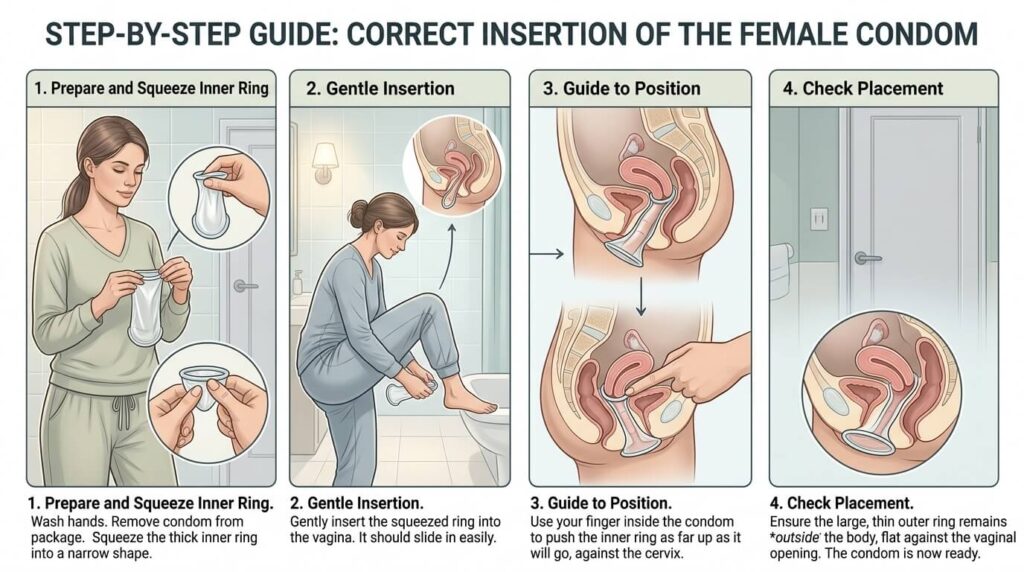
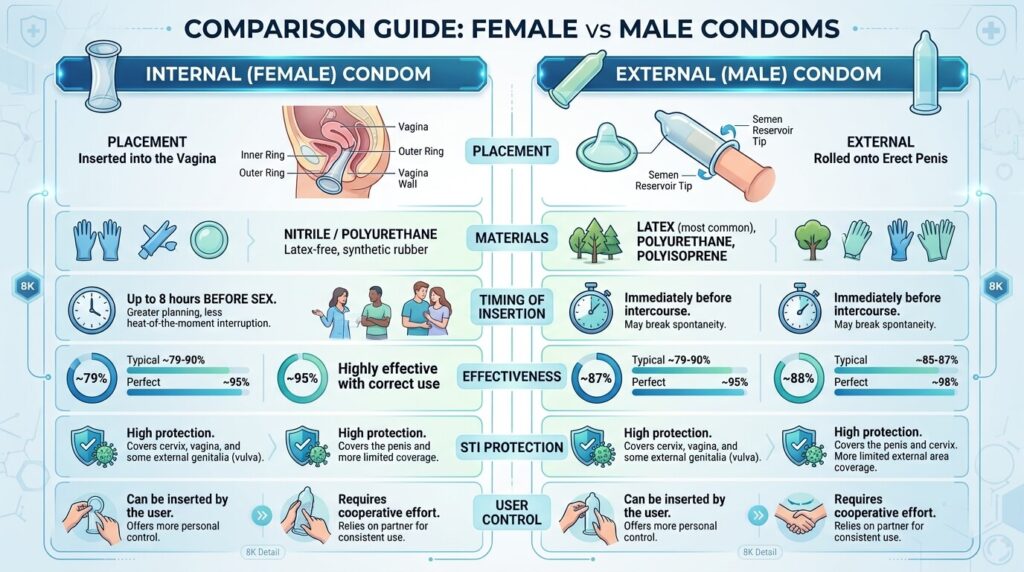
A female condom — increasingly called an internal condom — is a soft, thin pouch worn inside the vagina or anus during sex. It has two rings: a flexible inner ring that holds it in place against the cervix, and an outer ring that stays outside the body, covering the vaginal or anal opening.
Unlike male (external) condoms, which are worn on the penis, internal condoms are controlled by the person with a vagina or anus — making them one of the few barrier methods that offer autonomous contraceptive protection.
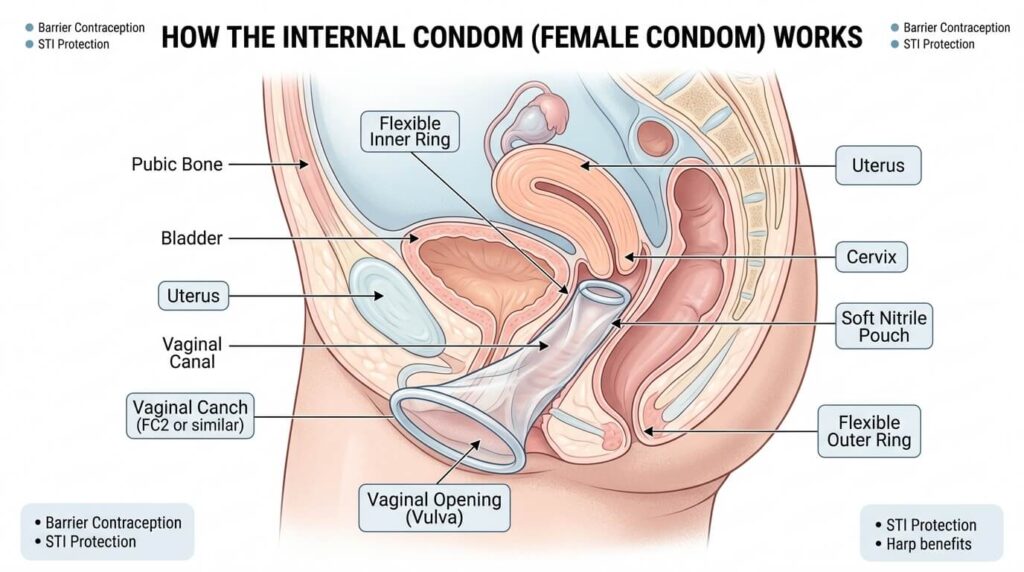
Most internal condoms are made from nitrile or polyurethane — synthetic, non-latex materials. Some are made from latex. In the United States, the FC2 Female Condom is the only FDA-approved internal condom brand. It is made from nitrile.
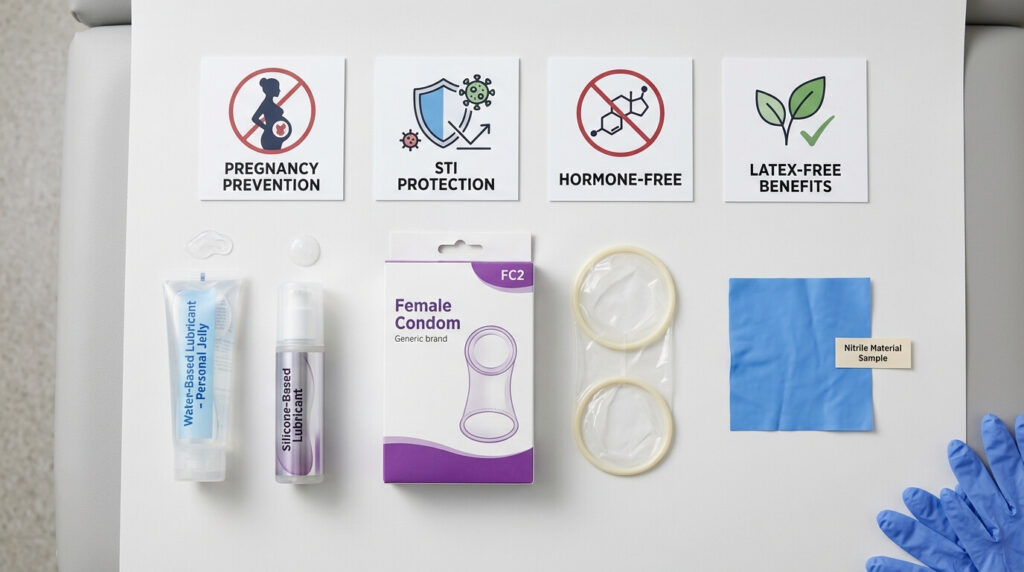
Female Condom vs. Male Condom: Key Differences at a Glance
| Feature | Internal (Female) Condom | External (Male) Condom |
|---|---|---|
| Worn by | Person with vagina/anus | Person with penis |
| Material | Nitrile, polyurethane, or latex | Latex, polyurethane, or polyisoprene |
| When to insert | Up to 8 hours before sex | Must be put on immediately before sex |
| Latex-free options | Yes (most brands) | Yes (some brands) |
| Effectiveness (perfect use) | ~95% | ~98% |
| Dual use with other condom | No — never use both together | No |
| Protects against STIs | Yes | Yes |
| Available with/without prescription | Without | Without |
Who Can Use a Female Condom?
Most people can use internal condoms safely. They are a particularly good choice for people who:
- Cannot use hormonal contraception (e.g., due to migraines, blood clot risk, or personal preference)
- Want protection that doesn’t rely on a partner
- Are sensitive to latex
- Want to use a condom that can be placed in advance
Are Female Condoms Safe for People with Latex Allergies?
Yes — most internal condoms, including the FC2, are made from nitrile, which is latex-free. If you or your partner has a latex allergy, always check the packaging to confirm the material before use. Do not use a latex internal condom if either person has a latex allergy or is using topical antifungal medication around the genitals, as this can degrade the material.
How to Use a Female Condom Step by Step
Before you begin, check the expiry date on the packet and look for a CE mark (EU), UKCA mark (UK), or FDA clearance notation (US) — this confirms the condom has been tested to safety standards. Open the packet carefully, without using your teeth or scissors.
Inserting a Female Condom for Vaginal Sex
- Find a comfortable position — squatting, lying down, or standing with one foot raised all work.
- Hold the inner ring (the closed end) and squeeze it between your thumb and forefinger so it narrows.
- Gently insert the squeezed inner ring into the vagina, similar to inserting a tampon.
- Use your index finger to push the inner ring as far up as it will go until it sits against the cervix. You shouldn’t feel it once it’s correctly placed.
- Make sure the outer ring hangs 2–3 cm outside the vaginal opening and that the condom is not twisted.
- Guide your partner’s penis through the outer ring and into the condom during sex. If at any point the penis slips between the condom and the vaginal wall, stop and reposition.
Tip for first-timers: Practice inserting the condom alone before using it during sex. This makes the process quicker and more comfortable when it matters.
Using a Female Condom for Anal Sex
Internal condoms can also be used for anal sex. Remove the inner ring first (since the anus naturally holds the condom in place), then insert the condom into the anus using a lubricated finger. Apply additional lubricant to the inside and outside of the condom before sex. The outer ring should remain outside the anus throughout.
How to Remove a Female Condom Correctly
After sex, twist the outer ring several times to seal in semen and prevent spillage. Gently pull the condom out and dispose of it in the bin — never flush it down the toilet. Do not reuse a condom.
Dos and Don’ts of Female Condom Use
Do:
- Use a new internal condom every time you have sex
- Add extra lubricant inside and around the condom for comfort and to reduce the risk of slipping
- Store condoms in a cool, dry place away from direct sunlight
- Check the packet is undamaged before use
Don’t:
- Use an internal condom at the same time as an external (male) condom — the friction increases tear risk
- Use oil-based lubricants with latex internal condoms (oil degrades latex)
- Reuse a condom
- Flush used condoms down the toilet
How Effective Are Female Condoms?
Effectiveness Against Pregnancy
With perfect use (correct technique every time), internal condoms are approximately 95% effective at preventing pregnancy. With typical use — accounting for the normal range of human error — effectiveness drops to around 79%, meaning roughly 1 in 5 people who rely on them over a year may become pregnant.
The most common reasons for failure include: inserting the condom after genital contact has already occurred, the penis entering outside the condom, or the condom slipping or tearing during sex.
Effectiveness Against STIs
When used correctly for vaginal sex, internal condoms significantly reduce the risk of STIs including HIV, gonorrhoea, chlamydia, and trichomoniasis. For anal sex, evidence suggests protective benefit, though the research base is less extensive than for vaginal use.
Benefits of Using Female Condoms
Internal condoms offer a distinct set of advantages that are often underappreciated:
- Hormone-free protection. Unlike the pill, patch, or hormonal IUD, internal condoms do not affect your body’s hormone levels — making them suitable for people who can’t or don’t want to use hormonal contraception.
- Dual protection. They are one of the few contraceptive methods that protect against both pregnancy and STIs simultaneously.
- You control the timing. You can insert a female condom up to 8 hours before sex — no need to interrupt the moment.
- Latex-free options available. Nitrile condoms are a safe alternative for people with latex allergies.
- No prescription needed. Internal condoms are available over the counter at pharmacies and online.
- Empowerment. Using a female condom puts contraceptive protection in the hands of the person wearing it, independent of a partner’s willingness to use an external condom.
What to Do If a Female Condom Slips, Breaks, or Leaks
If the condom slips, breaks, or the penis enters outside the condom during sex, don’t panic — but do act quickly.
- For pregnancy prevention: Emergency contraception (the morning-after pill) is most effective when taken as soon as possible after unprotected sex — ideally within 72 hours, though it can work up to 120 hours (5 days). Consult a pharmacist, sexual health clinic, or GP immediately.
- For STI risk: Get an STI test at a sexual health clinic. Many clinics offer same-day or walk-in appointments.
Lubricant Guide: What’s Safe to Use with Female Condoms
Adding lubricant makes insertion easier and reduces the chance of the condom tearing or slipping. Here’s what to use:
| Lubricant Type | Safe with Nitrile/Polyurethane? | Safe with Latex? |
|---|---|---|
| Water-based | ✅ Yes | ✅ Yes |
| Silicone-based | ✅ Yes | ✅ Yes |
| Oil-based (coconut oil, petroleum jelly, etc.) | ✅ Yes | ❌ No — degrades latex |
For anal sex, use generous amounts of lubricant and reapply as needed. The anus does not self-lubricate like the vagina, so adequate lubrication is especially important for both comfort and condom integrity.
Where to Buy Female Condoms (and What They Cost)
Internal condoms are less widely available than external condoms, but they are accessible through several channels:
- Sexual health clinics and family planning centres — often available free of charge
- Pharmacies — available over the counter without a prescription
- Online retailers — widely available; buying in bulk reduces per-unit cost
- GP surgeries (in some regions) — may provide them as part of contraception services
- Supermarkets — availability varies by country and region
In the US, the FC2 Female Condom typically retails for around $3–$5 per unit at pharmacies. In the UK and many European countries, they are available free through NHS sexual health services. If cost is a barrier, a sexual health clinic is always worth contacting.
Frequently Asked Questions About Female Condoms
Q: How effective are female condoms at preventing pregnancy?
A: With perfect use, internal condoms are around 95% effective. With typical use, effectiveness is approximately 79%. Using them consistently and correctly every time significantly improves protection.
Q: How do you insert a female condom correctly?
A: Squeeze the inner ring, insert it into the vagina or anus, and push it as far in as it will go. Make sure the outer ring remains outside the body and the condom is not twisted. Full steps are detailed in the section above.
Q: Can you use a female condom for anal sex?
A: Yes. Remove the inner ring, insert the condom into the anus using a lubricated finger, and use plenty of additional lubricant. Evidence suggests it offers STI protection for anal sex, though research is more limited than for vaginal use.
Q: What’s the difference between a female condom and a male condom?
A: A female (internal) condom is worn inside the body, while a male (external) condom is worn on the penis. Internal condoms can be inserted hours before sex, are mostly latex-free, and give the wearer autonomous contraceptive control.
Q: Can female condoms prevent STIs?
A: Yes. When used correctly, internal condoms protect against HIV, chlamydia, gonorrhoea, and other STIs transmitted through genital fluids or skin-to-skin contact.
Q: How far in advance can you insert a female condom?
A: You can insert an internal condom up to 8 hours before sex, making it convenient to use without interrupting the moment.
Q: What should you do if a female condom slips or breaks?
A: Seek emergency contraception (within 72–120 hours) if pregnancy is a concern, and visit a sexual health clinic for STI testing as soon as possible.
Q: Are female condoms safe for people with latex allergies?
A: Most internal condoms, including the FDA-approved FC2, are made from nitrile — a latex-free material. Always check the packaging to confirm the material before use.
Q: Can you use a female condom and a male condom together?
A: No. Using both simultaneously causes friction that increases the risk of tearing for both condoms. Use one or the other.
Q: Where can you get female condoms?
A: From sexual health clinics (sometimes free), pharmacies, online retailers, and some GP surgeries. Availability and cost vary by country.
Final Thoughts: Taking Control of Your Contraception
The use of female condoms is a practical, empowering choice for people who want hormone-free, dual-protection contraception that they control. While they require a little practice to use confidently, their effectiveness at preventing both pregnancy and STIs — combined with their latex-free design and the ability to insert them well before sex — makes them a genuinely valuable option in any contraceptive toolkit.
If you’re new to internal condoms, try inserting one alone first to get familiar with the fit and feel. Most people find them comfortable and unobtrusive once they’ve practiced a few times.