
If you’ve noticed cramps and discharge showing up together — with or without your period — you’re not imagining a pattern. These two symptoms are two of the most common things people track about their reproductive health, and for good reason: they change constantly, and it’s genuinely hard to know which combinations are routine and which ones need a doctor’s attention.
I’ll walk through what’s normal at each stage of the cycle, what different discharge colors and textures usually point to, the less-obvious causes most articles skip over (ovulation pain, UTIs, postpartum changes, perimenopause), and exactly when cramping and discharge together are a signal to get checked out rather than wait it out.
Quick Answer: The Most Likely Explanations
In most cases, cramps and discharge together mean one of three things:
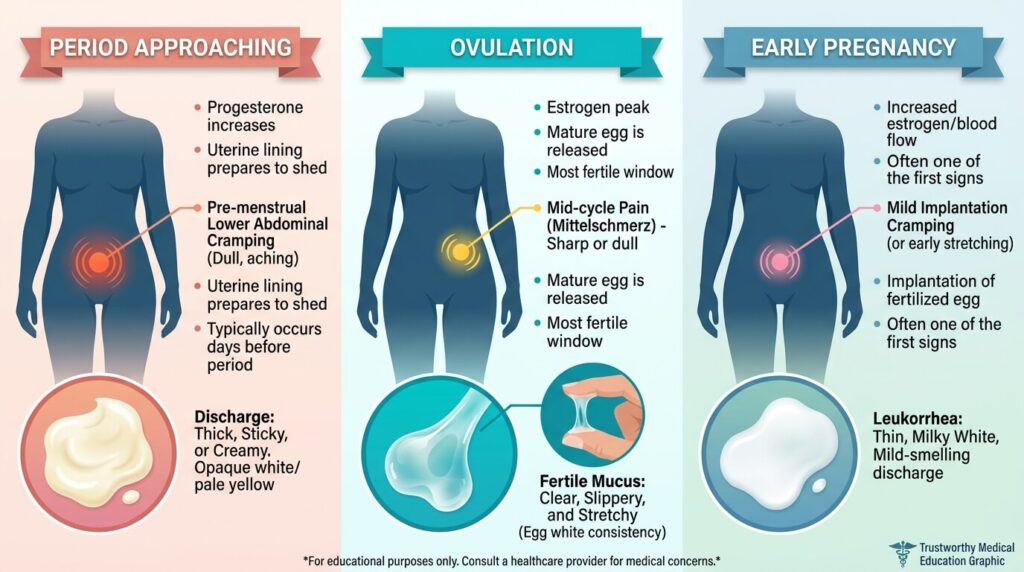
- Your period is approaching — cramping plus thicker, whiter discharge is a normal pre-menstrual pattern for many cycles.
- You’re ovulating — mid-cycle, roughly two weeks before your period, cramping (called mittelschmerz) can pair with clear, stretchy, egg-white discharge.
- You could be pregnant — especially if your period is late and the discharge is milky white with no odor.
If the discharge has a strong smell, unusual color (yellow, green, gray), or comes with itching, burning, or fever, that points toward an infection instead — and that’s worth treating rather than waiting out. We’ll break down each scenario below.
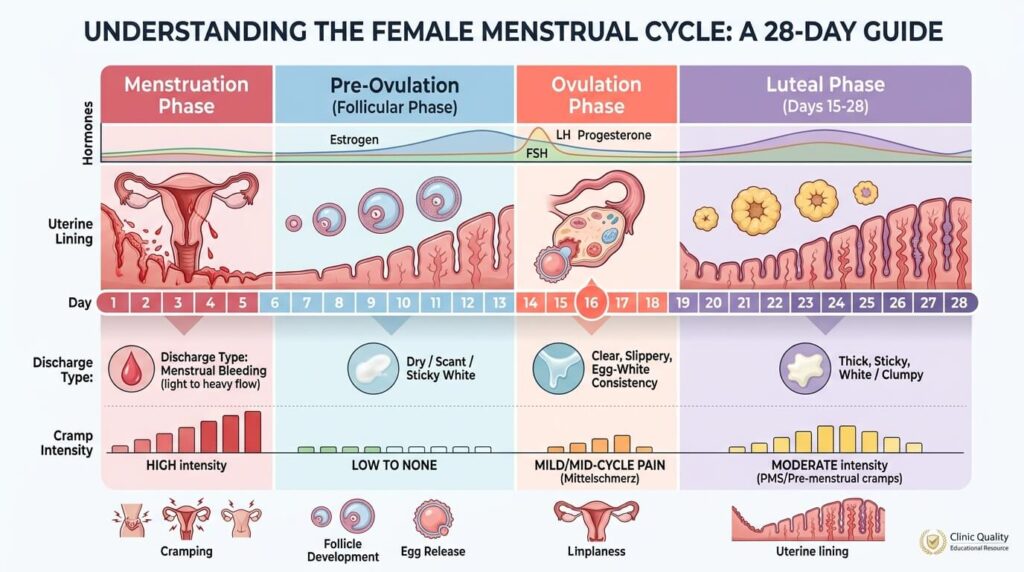
How Discharge Normally Changes Throughout Your Cycle
Discharge isn’t static — it shifts with your hormones roughly on a 4-week loop, and knowing your own pattern is the single best tool for spotting when something’s off.
| Cycle Phase | Typical Discharge | Cramping? |
|---|---|---|
| Right after your period | Little to none, or dry | Rare |
| Days 7–11 (pre-ovulation) | Creamy, white, sticky | Mild, occasional |
| Days 12–16 (ovulation) | Clear, stretchy, egg-white-like | Mittelschmerz (one-sided twinge) common |
| Days 17–25 (luteal phase) | Thicker, white, sometimes tacky | PMS cramping can start |
| Days 26–28 (pre-period) | Cloudy or white, sometimes with light spotting | Cramping intensifies |
I find it useful to think of this as a spectrum rather than fixed categories — your own cycle length and discharge amount can vary from the “textbook” version by several days and still be completely normal.
Cramps and White Discharge: The Most Searched Combination
White discharge with cramping — especially when a period hasn’t arrived yet — is the scenario most people search for, and it has a short list of likely explanations.
1. A Late or Approaching Period
Cloudy or white discharge for several days before bleeding starts is standard. If your period is only a few days late, this combination is often just your body’s normal countdown, not a red flag.
2. Early Pregnancy
Missing a period is the clearest pregnancy signal, and it’s often joined by:
- Milky white discharge (leukorrhea) that increases in early pregnancy
- Breast tenderness
- Fatigue
- Mild nausea
- One-sided lower-belly pulling or stretching, distinct from period cramps
Pregnancy cramps tend to feel like a dull stretch on one side rather than the rhythmic tightening of period pain, because they come from ligaments stretching to support the growing uterus rather than the uterus contracting. A home pregnancy test taken after a missed period is about 99% accurate when used correctly, but a blood test at a clinic can confirm results sooner and with more precision.
3. Ovulation
If cramps and white or clear stretchy discharge show up roughly two weeks before your expected period, ovulation is the likely cause. This cramping is usually brief — a few minutes to a couple of days — and confined to one side, switching sides from month to month depending on which ovary released an egg.
4. Hormonal Birth Control
Starting, stopping, or switching birth control (the pill, IUD, implant, or shot) commonly causes several months of irregular spotting, cramping, and discharge changes while your body adjusts. Hormonal IUDs in particular can cause cramping for the first 3–6 months after insertion.
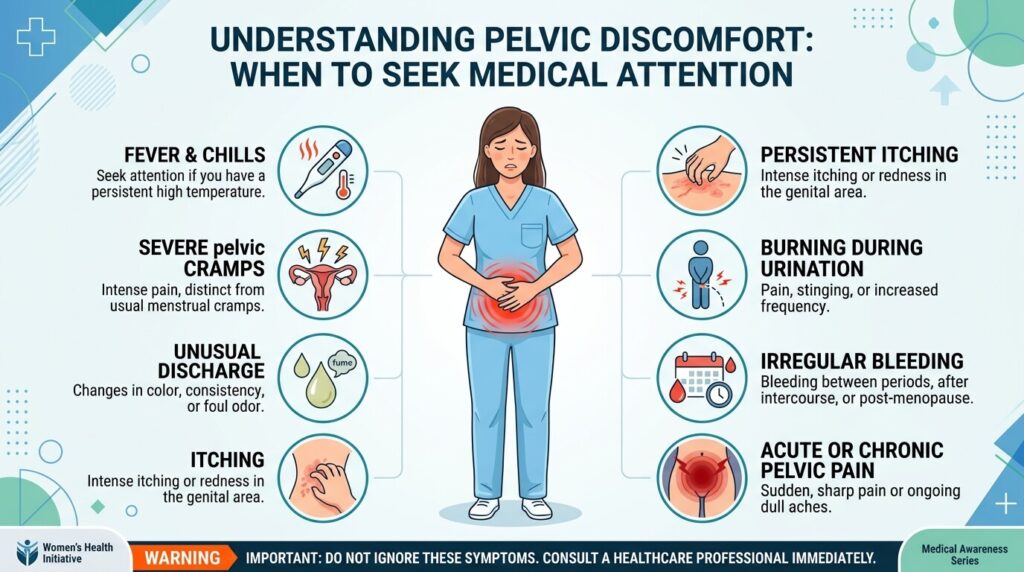
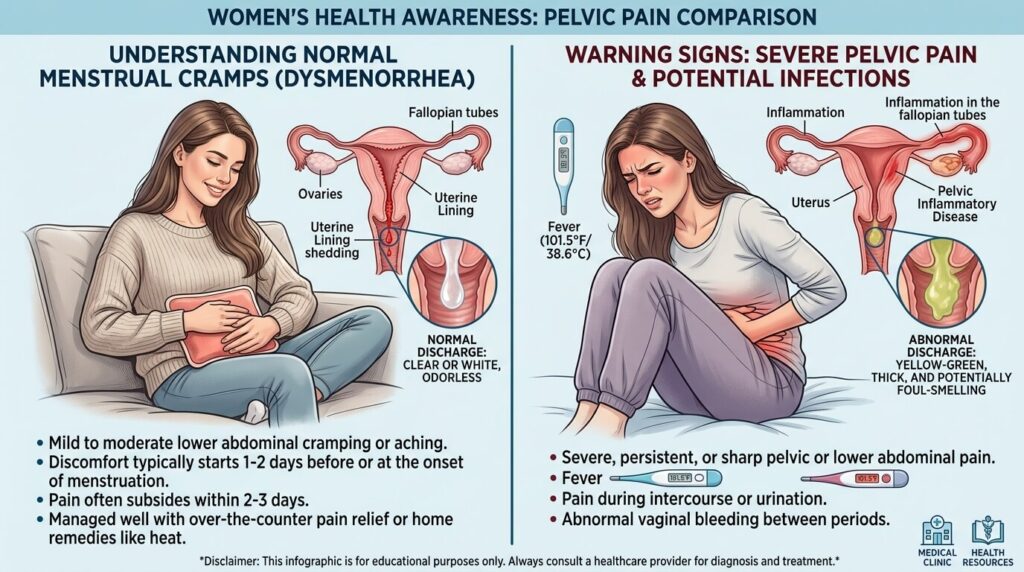
When Cramps and Discharge Signal an Infection
This is the category that gets the least specific coverage elsewhere, and it’s the one worth paying closest attention to, because early treatment prevents complications.
Bacterial Vaginosis (BV)
BV is the most common vaginal infection among women ages 15–44. It causes thin, grayish-white discharge with a distinct fishy odor that’s often stronger after sex, along with mild cramping or discomfort and sometimes itching.
Yeast Infection (Candidiasis)
A thick, white, cottage-cheese-like discharge with little to no smell, paired with intense itching and sometimes mild cramping, points toward a yeast infection. Roughly 3 out of 4 women experience at least one yeast infection in their lifetime.
Trichomoniasis
This STI produces greenish-yellow, frothy discharge with a strong odor, along with itching, soreness, and cramping or pelvic discomfort. Roughly 70% of people with trichomoniasis have no symptoms at all, which is part of why routine STI testing matters even when you feel fine.
Pelvic Inflammatory Disease (PID)
PID develops when an untreated infection — often chlamydia or gonorrhea — spreads upward into the uterus, fallopian tubes, or ovaries. It causes persistent lower-abdominal cramping, unusual discharge with an odor, pain during sex, burning during urination, and sometimes fever. Left untreated, PID can scar the fallopian tubes and raise the risk of infertility and ectopic pregnancy, so same-week medical attention is genuinely important here, not just “worth mentioning to your doctor eventually.”
Urinary Tract Infection (UTI)
UTIs don’t cause vaginal discharge directly, but the lower-abdominal cramping and pelvic pressure they cause are frequently mistaken for gynecological cramps, especially when discharge is present for an unrelated reason (like a normal cycle phase) at the same time. A burning sensation when urinating and a frequent, urgent need to pee are the distinguishing signs.
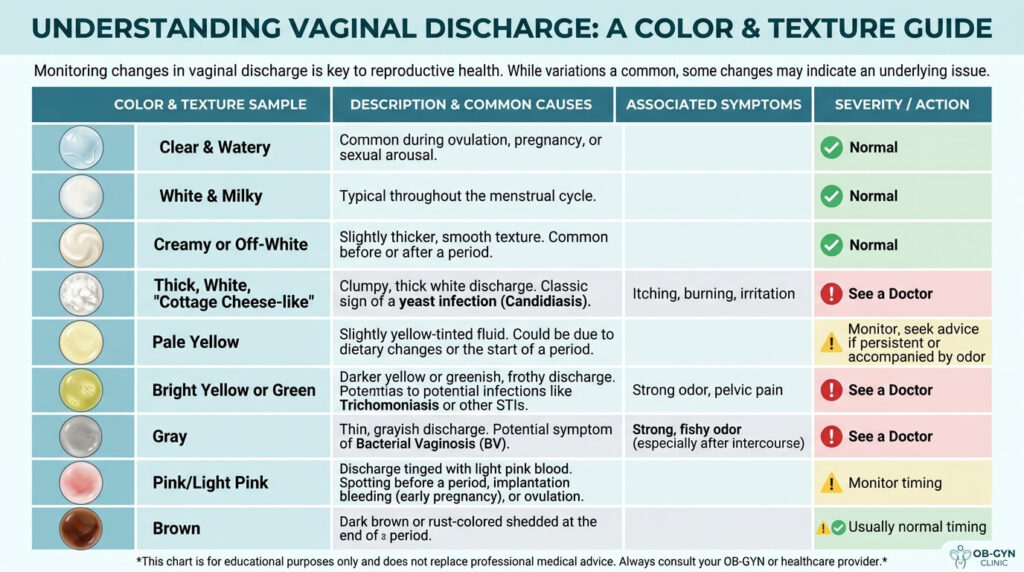
Discharge Color Guide: What Each Shade Usually Means
| Color/Texture | Likely Meaning | Action |
|---|---|---|
| Clear, stretchy | Ovulation | Normal |
| White, creamy | Pre-period or early pregnancy | Usually normal |
| Thick white, “cottage cheese” | Yeast infection | See a doctor if itching is present |
| Gray or thin white with fishy smell | Bacterial vaginosis | See a doctor |
| Yellow or green | Trichomoniasis, chlamydia, or gonorrhea | See a doctor promptly |
| Pink or brown spotting | Ovulation spotting, implantation, or irregular shedding | Usually normal if brief |
| Bright red, heavy | Period, or abnormal bleeding if off-cycle | Monitor; see a doctor if unexpected |
Other Causes Worth Knowing About
Most articles on this topic stop at infections and pregnancy. A few other causes deserve equal attention.
Endometriosis
Endometriosis happens when tissue similar to the uterine lining grows outside the uterus. It typically causes cramping that’s noticeably more severe than average period pain — often described as debilitating rather than just uncomfortable — along with irregular bleeding, pain during sex, and digestive symptoms like bloating or constipation around the period. Diagnosis on average takes several years from first symptoms, so persistent, severe cramping is worth raising with a doctor even if initial exams come back inconclusive.
Uterine Fibroids and Polyps
These noncancerous growths can cause cramping, pelvic pressure, and heavier-than-usual discharge or bleeding. Fibroids affect up to 70–80% of women by age 50, though many never cause symptoms.
Ovarian Cysts
Most ovarian cysts are harmless and resolve on their own, but a larger or ruptured cyst can cause sudden, sharp one-sided cramping, sometimes with unusual discharge if it affects hormone levels.
Perimenopause
As estrogen levels fluctuate in the years before menopause, periods and discharge patterns often become unpredictable — heavier or lighter, more or less frequent, with cramping that doesn’t follow the old schedule. This phase typically starts in the mid-to-late 40s but can begin earlier.
Postpartum Changes
After childbirth, cramping (afterpains) and a discharge called lochia — which shifts from red to pink to yellowish-white over about 4–6 weeks — are both expected. Afterpains are often stronger with second and later pregnancies because the uterus works harder to contract back to size.
Ectopic Pregnancy and Miscarriage
Sharp, one-sided cramping with spotting or bleeding during a period that could be a pregnancy always warrants prompt medical evaluation, since these can be early signs of ectopic pregnancy or pregnancy loss — both of which need timely diagnosis.
When to See a Doctor
Reach out to a healthcare provider if you notice:
- Discharge that smells strong, fishy, or foul
- Yellow, green, or gray discharge
- Discharge with itching, burning, or swelling
- Cramps that are severe, one-sided, or don’t improve with rest and OTC pain relief
- Fever alongside pelvic pain
- Bleeding between periods, after sex, or after menopause
- A missed period with a negative pregnancy test that stays negative after a week
- Pain during urination or sex alongside discharge changes
Seek urgent care the same day for sudden, severe abdominal pain, fainting, or heavy bleeding — these combinations can indicate an ectopic pregnancy or another emergency.
Self-Care and Prevention Tips
While you wait for an appointment, or for cramping tied to a normal cycle phase, these steps genuinely help:
- Use a heating pad on the lower abdomen for 15–20 minutes at a time
- Take ibuprofen or another NSAID, which also reduces prostaglandin-driven cramping (not just pain perception)
- Stay hydrated and reduce salt and caffeine in the days before your period to ease bloating
- Wear breathable cotton underwear and avoid tight synthetic fabrics
- Skip douching entirely — it disrupts the vagina’s natural bacterial balance and raises infection risk
- Track your cycle (paper or app) for 2–3 months so you know your personal baseline and can spot deviations faster
- Use condoms to reduce STI-related infection risk
Frequently Asked Questions
Is it normal to have cramps and discharge but no period?
Yes, in many cases. It commonly means your period is a few days away, you’re mid-cycle and ovulating, or you’re in early pregnancy. If it continues for more than a week with no period and a negative pregnancy test, see a doctor to rule out other causes like PCOS or thyroid changes.
What does watery discharge with cramps mean?
Watery discharge can appear around ovulation, in early pregnancy, or with a yeast infection or BV if it’s accompanied by odor or itching. On its own with no other symptoms, it’s usually just a normal cycle variation.
Can stress cause cramps and discharge changes?
Yes. High stress affects the hormones that regulate your cycle, which can delay periods, change discharge consistency, and intensify cramping. This is a real physiological effect, not just something people say — cortisol interferes directly with reproductive hormone signaling.
How do I know if my discharge is a sign of infection versus normal?
Normal discharge is usually clear to white, doesn’t have a strong odor, and doesn’t come with itching or burning. If any of those three things change — color, smell, or accompanying irritation — it’s worth getting checked, even if the cramping feels mild.
Can a UTI cause both cramps and discharge?
A UTI itself doesn’t produce discharge, but its cramping and pelvic pressure can feel similar to gynecological cramps and can occur at the same time as unrelated, normal discharge — which sometimes leads to confusion about the cause. Burning during urination is the key symptom that points to a UTI specifically.
Should I worry about brown discharge with cramps?
Brown discharge is usually just older blood leaving the body more slowly, common at the very start or end of a period, or around ovulation. It typically isn’t a concern unless it’s persistent, has an odor, or occurs alongside pain that doesn’t fit your usual pattern.