Cramps and white discharge but no period can mean a late cycle, early pregnancy, PCOS, infection, or more. Learn the causes, red flags, and what to do next. You’re cramping like your period should be days away. There’s a noticeable white discharge. And yet — nothing. No bleeding. If you’re checking the calendar for the third time today, you’re not alone, and you’re not necessarily pregnant either, even though that’s usually the first thought that comes to mind.
Cramps with white discharge but no period most often point to one of three things: an approaching or slightly delayed period, early pregnancy, or a hormonal shift unrelated to either. Less commonly, the combination can signal an infection, a structural issue like fibroids or polyps, or — rarely — something that needs urgent attention. This guide walks through every realistic cause, how to tell them apart, and exactly what to do next.
Quick Answer Cramps And White Discharge
If you have cramps, white discharge, and no period, consider these possibilities in order of likelihood:
- Your period is simply late. White, creamy discharge is normal in the days before menstruation, and ovulation can shift due to stress, travel, illness, or weight changes.
- You could be pregnant, especially if it’s been a week or more since your expected period. A home test taken with first-morning urine is the fastest way to check.
- A hormonal condition such as PCOS, thyroid dysfunction, or perimenopause is delaying or suppressing ovulation.
- An infection like bacterial vaginosis, a yeast infection, or pelvic inflammatory disease is changing your discharge and causing pelvic discomfort.
- A structural cause such as fibroids, polyps, or an ovarian cyst is producing cramping independent of your cycle.
Test for pregnancy if there’s any chance of it, track your symptoms for a few days, and contact a doctor if your period is more than a week late, your cramps are one-sided or worsening, or you notice fever, foul odor, or unusual bleeding.
How Discharge, Cramps, and Your Cycle Actually Connect
Most articles on this topic treat discharge and cramps as separate mysteries. They’re not — both are downstream effects of the same hormonal cycle, and understanding that cycle makes the rest of this guide much easier to interpret.
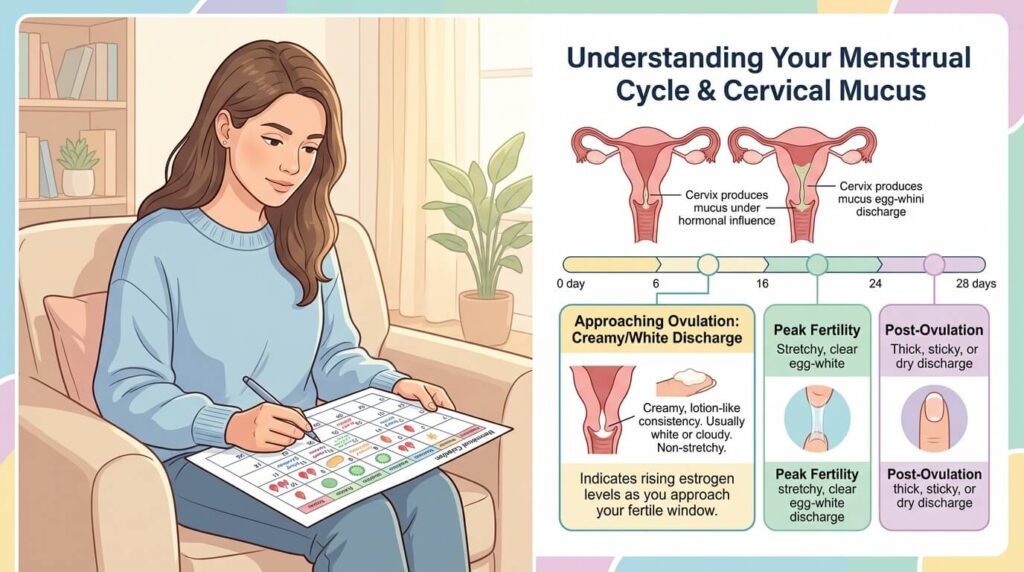
Why discharge turns white and creamy before a period
After ovulation, your body enters the luteal phase, when the ruptured follicle (now called the corpus luteum) produces progesterone. Progesterone thickens cervical mucus, shifting it from the clear, stretchy texture of ovulation to a thicker, whiter, creamier consistency. This is completely normal and is one of the most common reasons for white discharge with no period yet — your body is simply in the second half of its cycle, preparing either for a period or for a possible pregnancy.
Why cramps can happen without any bleeding
Cramping is caused by prostaglandins, hormone-like compounds that trigger uterine muscle contractions. Prostaglandin levels rise in the luteal phase regardless of whether a fertilized egg implants, which means you can feel period-like cramps for days before bleeding starts, or even if a period doesn’t arrive at all that cycle. In anovulatory cycles (cycles where an egg isn’t released), the uterine lining can still thicken and cause cramping sensations without a clear bleed, which is part of why “no period” doesn’t always mean “nothing is happening.”
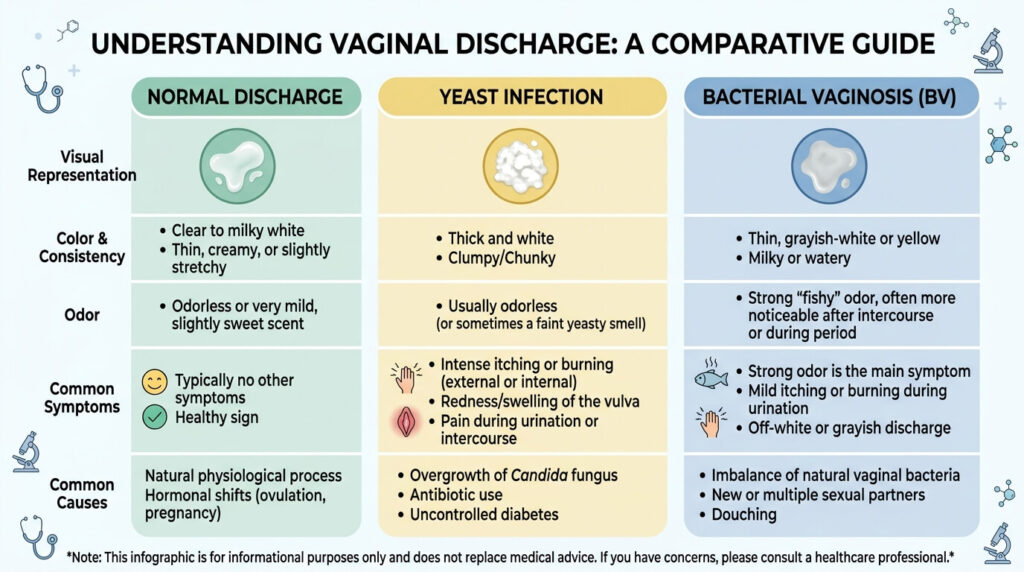
Discharge Decision Guide: Color, Texture, and What It Suggests
| Discharge appearance | Texture | Most likely meaning | Action |
|---|---|---|---|
| Clear, stretchy (egg-white) | Slippery, stretches between fingers | Ovulation, fertile window | Normal — no action needed |
| White or cream-colored | Thick but smooth, lotion-like | Luteal phase, late period, or early pregnancy | Track and wait, or test for pregnancy |
| Thick, white, clumpy (cottage-cheese-like) | Clumpy, often itchy | Yeast infection | Consider antifungal treatment or see a doctor |
| Thin, grey or white with strong odor | Watery, fishy smell, especially after sex | Bacterial vaginosis | See a doctor for testing and treatment |
| Yellow or green | Often frothy or thick | Infection, possible STI (e.g., trichomoniasis, gonorrhea) | See a doctor promptly |
| Brown or pink-tinged | Light, spotting-like | Old blood, possible implantation spotting, or late period starting | Test for pregnancy; monitor |
| Heavy and watery, no odor | Thin, clear to milky | Hormonal fluctuation, sometimes pregnancy-related | Track timing; test if period is late |
If your discharge has no odor, no itching, and no unusual color, it’s very likely a normal part of your cycle. Discharge that smells strong, looks discolored, or comes with itching or burning is the clearest signal that an infection — not a delayed period — is the more likely explanation.
Could You Be Pregnant?
Pregnancy is the explanation most people search for first, and it’s a reasonable one to rule out, but it’s far from the only possibility — something competitor articles tend to overstate by leading with pregnancy before covering anything else.
Early signs beyond a missed period
Alongside cramps and white or whitish-yellow discharge, early pregnancy can involve breast tenderness, fatigue, nausea, a heightened sense of smell, mild spotting, frequent urination, and bloating. None of these symptoms are exclusive to pregnancy — fatigue and bloating, for instance, are also classic premenstrual symptoms — which is exactly why testing is more reliable than symptom-spotting alone.
Implantation cramping versus PMS cramping
Implantation typically occurs six to twelve days after ovulation, often producing mild, brief cramping and sometimes light pink or brown spotting (not full discharge in the white sense). Premenstrual cramping, by contrast, tends to build gradually in the days leading up to a period and is usually felt centrally in the lower abdomen rather than on one side. Neither pattern is diagnostic on its own — the timing only becomes useful once paired with a test.
When and how to test for accurate results
Home pregnancy tests detect human chorionic gonadotropin (hCG) in urine. hCG levels roughly double every 48 to 72 hours in early pregnancy, but they need time to build up to a detectable level.
- Test on or after the first day of your missed period for the most reliable result.
- Use first-morning urine, which is more concentrated.
- Avoid testing immediately after drinking large amounts of fluid, which can dilute hCG.
- If the result is negative but your period still hasn’t started in 3 to 5 days, retest — early tests can produce false negatives if taken too soon.
Negative test, still no period — now what?
A negative test combined with a delayed period most often points to a late ovulation, anovulatory cycle, or one of the hormonal causes covered below rather than to a very early, undetectable pregnancy. If your period is more than a week late and tests remain negative, it’s reasonable to book an appointment for a blood test (which detects hCG earlier and more sensitively than urine tests) and a general hormone check.
Hormonal and Cycle-Related Causes
A simply late or anovulatory cycle
Ovulation timing isn’t fixed — illness, travel, poor sleep, intense exercise, or even a stressful week at work can push ovulation later, which pushes your entire period later. In some cycles, ovulation doesn’t happen at all (anovulation), which can still produce premenstrual-style cramping and discharge without a period following.
Stress and the HPA axis
Chronic stress activates the hypothalamic-pituitary-adrenal (HPA) axis, raising cortisol. Elevated cortisol can suppress the signals your hypothalamus sends to your ovaries, delaying or skipping ovulation entirely. This is a genuine physiological mechanism — not just “stress affects everything” — and it’s one of the most common, most overlooked causes of a late period with PMS-like symptoms.

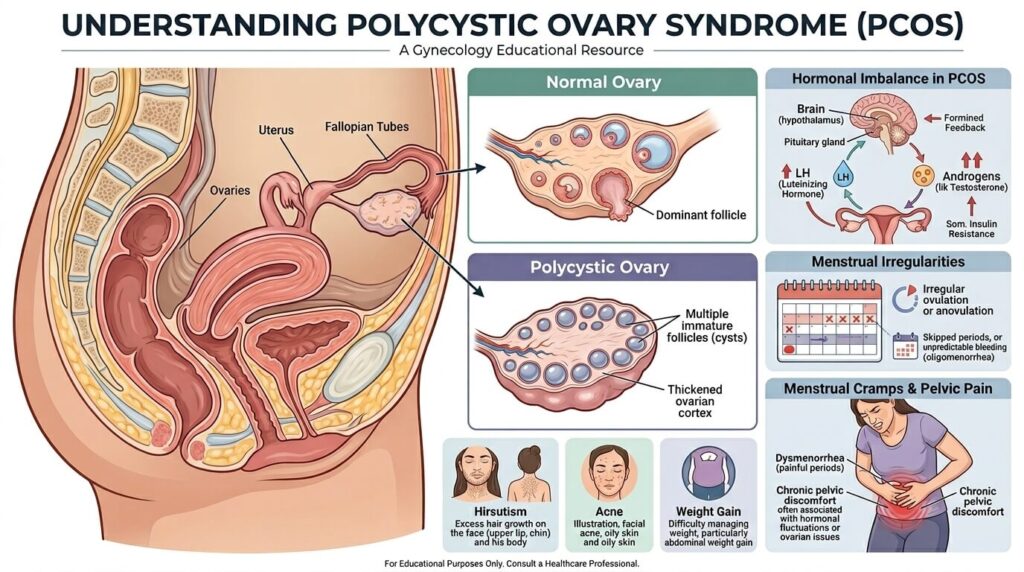
Polycystic ovary syndrome (PCOS)
PCOS is a hormonal condition involving irregular or absent ovulation, often alongside elevated androgens. It commonly causes infrequent, irregular, or missing periods, along with cramping, acne, and excess hair growth in some people. Diagnosis usually involves blood tests for hormone levels and a pelvic ultrasound. Treatment ranges from hormonal birth control to manage cycles, to metformin or lifestyle changes for insulin resistance, depending on individual goals (including fertility plans).
Perimenopause
Perimenopause — the transition phase before menopause, typically starting in the 40s but sometimes earlier — involves fluctuating estrogen and progesterone. Periods can become irregular, lighter, heavier, or skip entirely, often alongside hot flashes, night sweats, and mood changes. Cramping without bleeding is common as the body’s hormonal signaling becomes less predictable.
Thyroid disorders
Both an underactive thyroid (hypothyroidism) and an overactive one (hyperthyroidism) can disrupt the menstrual cycle, sometimes causing missed periods and cramping. Thyroid hormone interacts directly with the hormones that regulate ovulation, so an unexplained pattern of missed periods is a common reason doctors order a thyroid-stimulating hormone (TSH) test.
Birth control, IUDs, and other medications
Starting, stopping, or switching hormonal birth control (pills, patches, rings, implants, or the hormonal IUS) commonly causes irregular bleeding patterns, including missed periods with cramping, for the first three to six months. Non-hormonal copper IUDs can cause cramping independent of cycle timing, especially in the months after insertion. Certain other medications — antidepressants, antipsychotics, steroids, and blood thinners — can also alter cycle regularity.
Structural Causes
Uterine fibroids
Fibroids are noncancerous growths in or on the uterine wall. They can cause cramping, pelvic pressure, and irregular bleeding patterns, though they more often cause heavier rather than absent periods. Diagnosis is typically via pelvic ultrasound; treatment ranges from monitoring (for small, symptom-free fibroids) to medication or surgical removal for larger or symptomatic ones.
Endometrial or cervical polyps
Polyps are small, usually benign growths on the uterine lining or cervix. They can cause cramping and irregular discharge or spotting between periods. They’re often found incidentally during a pelvic exam or ultrasound and can be removed with a minor outpatient procedure if they’re causing symptoms.
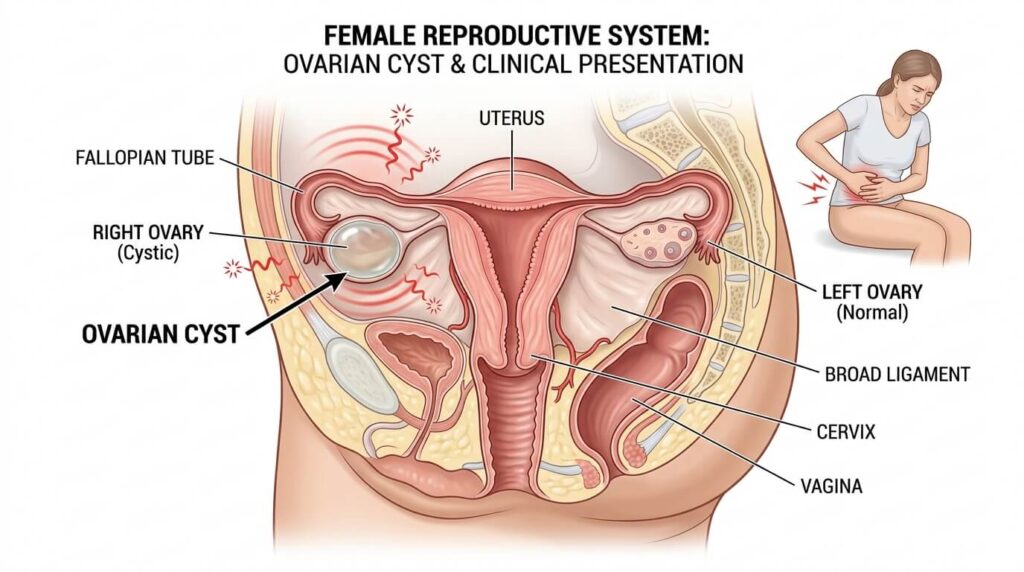
Ovarian cysts
Most ovarian cysts are functional and harmless, forming and resolving naturally during the menstrual cycle. Larger cysts, or one that ruptures or twists (ovarian torsion), can cause sudden, often one-sided cramping or sharp pain — a pattern worth mentioning to a doctor, especially if the pain is severe or comes on suddenly.

Endometriosis
Endometriosis occurs when tissue similar to the uterine lining grows outside the uterus, commonly on the ovaries, fallopian tubes, or pelvic lining. It’s strongly associated with severe period pain, but it can also cause cramping between periods, pain during sex, gastrointestinal symptoms, and fertility difficulties. Diagnosis often takes years on average because symptoms overlap with other conditions; a pelvic exam, imaging, and sometimes laparoscopic surgery are used to confirm it. There’s no cure, but hormonal therapy, pain management, and surgery can meaningfully reduce symptoms.
Infections Behind Cramps and Unusual Discharge
Bacterial vaginosis (BV)
BV results from an imbalance in normal vaginal bacteria. It typically produces a thin, grey-white discharge with a distinct fishy odor, sometimes alongside mild cramping or discomfort. It’s diagnosed with a simple vaginal swab and treated with prescription antibiotics. BV is common and not classified as an STI, though sexual activity can influence vaginal flora.
Yeast infection (vaginal candidiasis)
An overgrowth of candida yeast causes thick, white, clumpy discharge often compared to cottage cheese, along with itching, irritation, and sometimes mild cramping or discomfort during urination or sex. Over-the-counter antifungal treatments resolve most cases, but recurring or unclear cases warrant a doctor’s exam to confirm the diagnosis rather than repeated self-treatment.
Pelvic inflammatory disease (PID)
PID is an infection of the upper reproductive organs, usually resulting from an untreated STI such as chlamydia or gonorrhea. It can cause cramping, abnormal or heavy discharge, pain during sex, fever, and irregular periods — though some cases produce few or no obvious symptoms, which makes it easy to miss. Diagnosis involves a pelvic exam, STI testing, and sometimes imaging; treatment is a course of antibiotics, and early treatment is important because untreated PID can lead to infertility or chronic pelvic pain.
Sexually transmitted infections (STIs)
Beyond PID, infections like chlamydia, gonorrhea, and trichomoniasis can independently cause unusual discharge, cramping, and irregular bleeding, sometimes with no other symptoms at all. Regular STI screening — and prompt testing after any new or unprotected sexual contact — is the most reliable way to catch these early, since symptoms alone are often unreliable.
Other Causes Worth Knowing
Irritable bowel syndrome (IBS) and digestive issues
Because the bowel and reproductive organs sit close together and share some nerve pathways, IBS can cause lower abdominal cramping that feels very similar to period pain, along with bloating and bowel changes. IBS symptoms often intensify around the menstrual cycle even when they’re not directly caused by it, which can make the two easy to confuse.
Ectopic pregnancy
An ectopic pregnancy implants outside the uterus, most often in a fallopian tube. Early on, it can mimic normal pregnancy symptoms — including cramping and a missed period — but it typically progresses to sharp, often one-sided pain, and can cause shoulder pain or dizziness as it advances. This is a medical emergency; a positive pregnancy test combined with severe or one-sided pain needs immediate medical attention.
Early miscarriage or chemical pregnancy
A very early pregnancy loss (sometimes called a chemical pregnancy) can present as cramping with a period that arrives a few days late and is sometimes heavier than usual, occasionally with a positive pregnancy test shortly beforehand. Many people never realize this has happened, since it can closely resemble a slightly delayed, slightly different period.
Cervical cancer (rare, but important to rule out)
Cervical cancer is uncommon and often symptom-free in its early stages, but as it progresses it can cause unusual discharge, pelvic pain, and bleeding between periods or after sex. It’s mentioned here not to alarm, but because routine cervical screening (Pap and HPV testing) is the actual safeguard — symptoms alone are not an early warning system, which is precisely why screening guidelines exist.
Common Mistakes to Avoid
- Testing for pregnancy too early and treating a single negative result as final, instead of retesting a few days later.
- Self-diagnosing a yeast infection repeatedly without confirming it with a doctor, especially when symptoms don’t fully resolve with over-the-counter treatment — this delays catching BV, STIs, or other causes with overlapping symptoms.
- Ignoring one-sided or worsening pain, which is one of the more reliable red flags for cysts, ovarian torsion, or ectopic pregnancy.
- Douching in an attempt to “fix” discharge, which actually disrupts healthy vaginal bacteria and can make infections more likely.
- Assuming stress is “just in your head” rather than recognizing it as a real hormonal mechanism that can delay a period for weeks.
- Waiting too long to see a doctor when a period is significantly late and home testing isn’t providing answers.
What to Do, Step by Step
- Take a pregnancy test if there’s any chance of pregnancy, ideally on or after the day your period was due.
- Track your symptoms for several days — note discharge color, odor, texture, cramp location, and any other changes (fatigue, mood, bloating, spotting).
- Rule out simple explanations like recent stress, travel, illness, or a new medication or birth control method.
- Retest in 3–5 days if your first pregnancy test was negative and your period still hasn’t arrived.
- Book a doctor’s appointment if your period is more than 7–10 days late, symptoms persist beyond two weeks, or your discharge looks or smells abnormal.
- Bring a record of your last few cycle lengths and symptom notes to the appointment — this speeds up diagnosis considerably.
When to Seek Care Urgently
Contact a doctor or seek urgent care the same day if you notice:
- Severe pain, especially if it’s sudden, one-sided, or worsening
- A positive pregnancy test combined with sharp pain, dizziness, or shoulder pain (possible ectopic pregnancy)
- Fever or chills alongside pelvic pain or unusual discharge
- Discharge that is green, yellow, grey, or has a strong odor
- Heavy bleeding that soaks through protection within an hour
- Fainting or feeling like you might pass out
Prevention and Cycle-Tracking Tips
- Track your cycle with an app or calendar to establish your personal baseline for discharge changes and cramp timing — what’s “normal” varies meaningfully between individuals.
- Manage stress through sleep, regular movement, and workload pacing, since cortisol’s effect on ovulation is one of the most common and most fixable causes of a delayed period.
- Use barrier protection (condoms) to reduce STI risk, which lowers the chance of PID and related infections.
- Avoid douching and scented vaginal products, which disrupt the natural bacterial balance and increase infection risk.
- Keep up with routine cervical screening per your healthcare provider’s recommended schedule.
- Note any new medication or birth control change in your tracking app, since these are common, often-overlooked causes of irregular cycles.

Comparison Table: Causes at a Glance
| Cause | Key differentiating clue | Typical next step |
|---|---|---|
| Late/anovulatory cycle | No other red-flag symptoms; resolves within 1–2 weeks | Track and wait |
| Pregnancy | Missed period 7+ days, possible nausea/breast tenderness | Home test, repeat if negative |
| Stress-related delay | Recent major stressor, illness, or travel | Stress management, retest timing |
| PCOS | Recurrent irregular periods, acne, excess hair growth | Hormone blood tests, ultrasound |
| Perimenopause | Age 40+, hot flashes, night sweats | Doctor evaluation, hormone tests |
| Thyroid disorder | Fatigue, weight changes, temperature sensitivity | TSH blood test |
| Birth control change | Recent start/stop/switch of contraception | Wait 3–6 months, monitor |
| Fibroids/polyps | Pelvic pressure, irregular spotting | Pelvic ultrasound |
| Ovarian cyst | Sudden or one-sided pain | Ultrasound; urgent care if severe |
| Endometriosis | Long history of severe period pain, pain during sex | Pelvic exam, imaging, specialist referral |
| Bacterial vaginosis | Thin grey discharge, fishy odor | Vaginal swab, antibiotics |
| Yeast infection | Thick clumpy discharge, itching | Antifungal treatment |
| PID/STI | Fever, pain during sex, recent unprotected contact | STI testing, antibiotics |
| Ectopic pregnancy | Positive test + sharp one-sided pain or dizziness | Emergency care |
FAQ Cramps And White Discharge
Is white discharge with cramps but no period normal?
Yes, in many cases. White, creamy discharge is typical of the luteal phase, and prostaglandin-driven cramping commonly precedes a period by several days. It’s only a concern if the discharge has an unusual odor, color, or comes with other symptoms like fever or severe pain.
How many days late does a period need to be before I worry?
A period that’s 1–5 days late is common and usually not a concern. If you’re more than 7–10 days late with a negative pregnancy test, it’s reasonable to see a doctor for hormone testing.
Can stress alone delay my period for weeks?
Yes. Chronic stress raises cortisol, which can suppress the hormonal signals needed for ovulation, sometimes delaying a period by one to several weeks.
What does it mean if I have cramps on only one side?
One-sided cramping can come from ovulation (mittelschmerz), an ovarian cyst, or — if combined with a positive pregnancy test — an ectopic pregnancy. Persistent or severe one-sided pain should be evaluated promptly.
Can a UTI cause cramps and discharge without a period?
A urinary tract infection mainly causes burning during urination and lower abdominal discomfort rather than vaginal discharge, but the pelvic pain can feel similar to cramping. If burning or urgency is present, a UTI should be considered alongside other causes.
How soon after sex can I take a pregnancy test?
Most tests are reliable starting on the first day of a missed period, which is generally at least 12–14 days after ovulation (and therefore after the sexual encounter that could have led to conception).
Could my birth control be causing this?
Yes. Starting, stopping, or switching hormonal contraception commonly causes missed periods, breakthrough cramping, and changes in discharge for the first several cycles.
Is brown or pink discharge instead of white discharge a different concern?
Brown or pink discharge usually indicates small amounts of old or fresh blood, which can mean a period is starting, implantation spotting, or hormonal fluctuation. White discharge alone typically reflects normal cervical mucus changes.
Can PCOS cause cramps without a period?
Yes. Irregular or absent ovulation in PCOS can still produce hormonal fluctuations and cramping sensations even when a full period doesn’t follow.
Should I be worried about cervical cancer if I have these symptoms?
Cramps and white discharge alone are very unlikely to indicate cervical cancer, which is uncommon and usually symptom-free early on. Staying current with cervical screening is the most effective safeguard, rather than monitoring for symptoms.
What’s the difference between PID and a regular infection like BV?
BV is a vaginal bacterial imbalance that typically stays localized and causes odor and discharge changes. PID is an infection that has spread to the uterus, fallopian tubes, or ovaries, and usually comes with more significant pain, possible fever, and a higher risk of long-term complications if untreated.
Can perimenopause start in my 30s?
It’s uncommon but possible — most people enter perimenopause in their mid-to-late 40s, though some begin earlier. Irregular periods before age 40 are usually worth discussing with a doctor to rule out other causes first.
Why does my discharge smell different when my period is late?
Hormonal shifts change the vaginal pH and bacterial balance slightly throughout the cycle, which can subtly affect odor even without an infection. A strong, persistent, or fishy odor is different from this normal variation and is worth checking with a doctor.
Is it possible to be pregnant with a completely negative test?
It’s uncommon but possible if testing was done too early, urine was too diluted, or the test was used or read incorrectly. If suspicion remains high, a blood test at a doctor’s office is more sensitive than a home urine test.