
Newborns and rice cereal is a common topic for new parents. Learn when babies can safely start rice cereal, possible risks, and expert feeding advice. If you’ve ever mentioned your baby is fussy or waking up all night, chances are someone—your mom, your neighbor, your well-meaning coworker—has leaned in and whispered, “Have you tried rice cereal in the bottle?”
It sounds so simple. A little rice cereal, a fuller belly, a sleeping baby. For decades, that advice was practically gospel. But what was once considered a harmless parenting shortcut is now something pediatricians, the American Academy of Pediatrics (AAP), and the FDA are actively warning against—especially for newborns.
So what’s the real deal with newborns and rice cereal? When is it actually safe, what are the risks you need to know about, and what should your baby be eating instead? This article breaks it all down, backed by the latest research and current expert guidance.
What Is Infant Rice Cereal?
Infant rice cereal is a finely ground powder made from milled rice, typically fortified with iron and other key nutrients like zinc, calcium, and B vitamins. For generations, it was marketed as the perfect “first food” for babies—bland enough to be gentle on tiny stomachs, easy to mix with breast milk or formula, and reportedly filling enough to help babies sleep longer.
It became so popular that many families started offering it to babies as young as a few weeks old—mixed into bottles, spoon-fed at two months, or stirred into formula to treat reflux.
Here’s the problem: almost all of that advice is now contradicted by current science and medical guidelines. Also read how to calculate when your next period is?
Should Newborns Have Rice Cereal? The Short Answer Is No.
Let’s be direct. Newborns should not eat rice cereal. Not in a bottle, not on a spoon, not in any form.
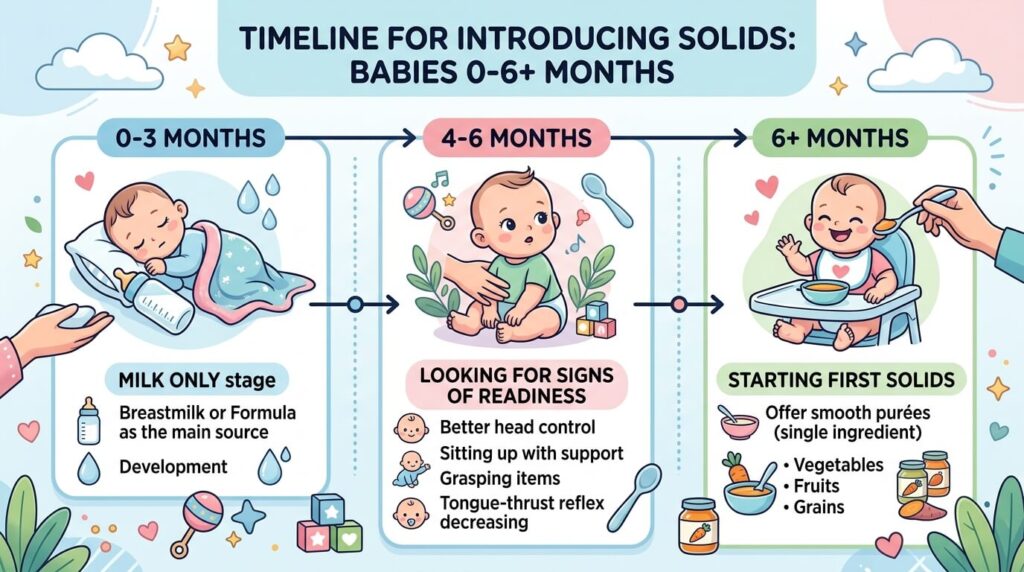
The AAP and the CDC both recommend exclusive breast milk or formula feeding for the first six months of life, and strongly advise against introducing any solid foods—including rice cereal—before at least four months of age.
There are several important reasons for this:
1. The digestive system isn’t ready. A newborn’s gut is still developing. Their digestive enzymes, particularly amylase (which breaks down starch), aren’t mature enough to process cereal grains effectively. Introducing solids too early can cause digestive distress, constipation, and discomfort.
2. The tongue-thrust reflex is still active. Babies under four months have an automatic reflex that pushes foreign objects out of their mouths. It’s a protective mechanism. When you put cereal on a newborn’s tongue, their body naturally tries to push it out—and they often end up inhaling it instead of swallowing it. This is a choking and aspiration risk.
3. Head and neck control is insufficient. Safely eating solid food requires a baby to have meaningful head and neck control so they can manage the mechanics of swallowing. Newborns simply don’t have this yet.
4. Breast milk and formula are complete nutrition. Unlike adults, babies don’t need variety in their diet for the first several months. Breast milk (or formula) provides every macro and micronutrient a newborn requires. Adding cereal doesn’t improve nutrition—it displaces it.
The “Put Rice Cereal in the Bottle” Myth, Debunked
This advice has persisted across generations. The reasoning sounds logical: make the baby’s milk heavier, they’ll feel full longer, they’ll sleep more, everyone wins.
Except that’s not what the research shows.
Multiple studies have found no meaningful connection between adding rice cereal to bottles and longer infant sleep. Babies wake up at night because of their developmental stage and biological needs—not because they’re hungry. Sleep patterns in early infancy are regulated by internal circadian rhythm development, not by how full a baby’s stomach is.
And the risks of doing it anyway? Very real:
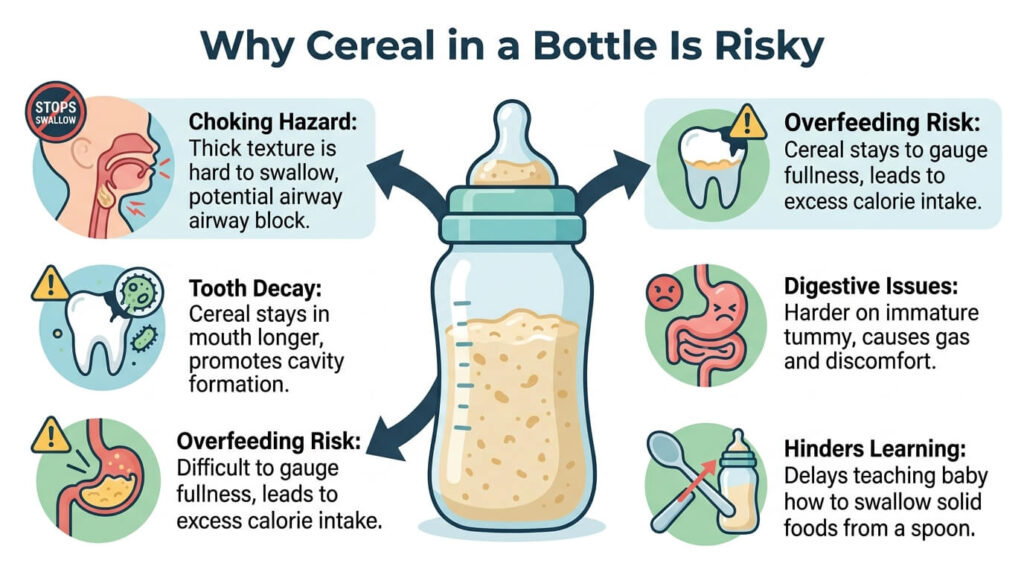
- Choking and aspiration. Adding cereal to a bottle thickens the liquid but doesn’t reduce the risk of it entering the airway. For newborns without strong oral motor control, this is genuinely dangerous.
- Overfeeding and excess weight gain. Breast milk and formula have a specific caloric density. Adding cereal significantly increases calorie intake beyond what a baby needs, which research links to higher obesity risk in childhood.
- Digestive trouble. Thickened feeds can cause constipation and gas, particularly in very young babies.
- Oral motor delays. When babies get used to drinking thick liquids, they may struggle to transition to the texture of normal solid foods later on.
- Nutritional dilution. If a baby fills up on cereal-thickened formula, they may drink less milk—and breast milk or formula has far more complete nutrition than rice cereal alone.
The CDC is explicit on this: putting cereal in a baby’s bottle will not make them sleep longer, and it increases the risk of choking.
When Can Babies Actually Start Rice Cereal?
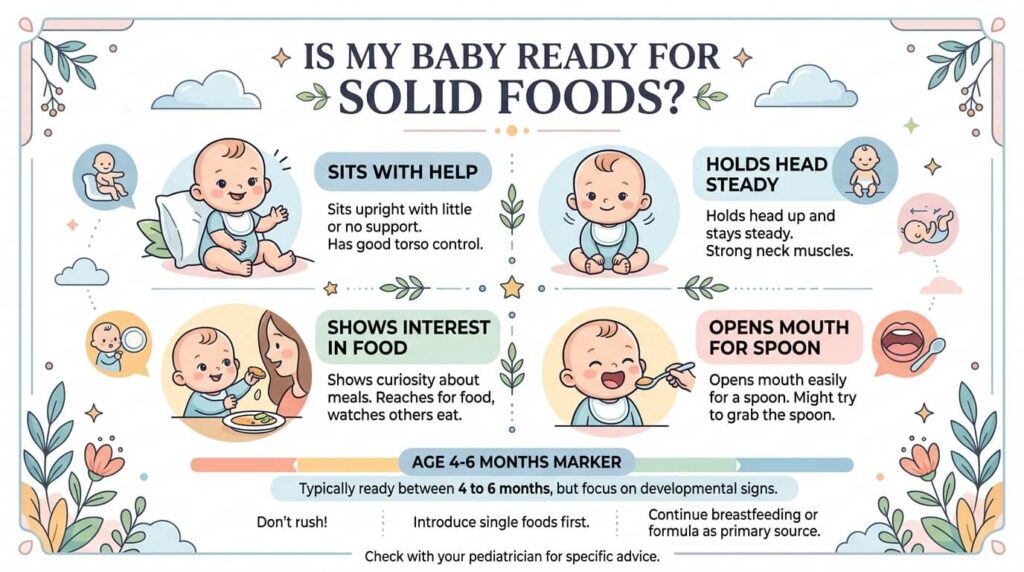
If rice cereal is going to be introduced at all, it should only be done once a baby shows all the classic readiness signs for solid foods—typically around four to six months of age. Age alone isn’t the determining factor; look for these developmental milestones:
- Holds head steady and upright without support
- Sits with minimal assistance, with good core stability
- Shows interest in food—watching intently when others eat, reaching toward food
- Has lost the tongue-thrust reflex—doesn’t automatically push food out when it touches the tongue
- Has doubled their birth weight and weighs at least 13 pounds
Most babies reach all of these milestones somewhere between five and six months. Some reach them at four months; some not until six or seven. Every baby’s timeline is different, and it’s worth discussing with your pediatrician before making the leap.
The Arsenic Problem: What Parents Aren’t Told
Here’s the part of the rice cereal conversation that doesn’t get enough airtime: rice naturally absorbs arsenic from soil and water at levels far higher than other grains.
Inorganic arsenic is a known carcinogen. It’s also been linked to impaired cognitive development, immune dysfunction, and cardiovascular problems—even at low levels of exposure. And for babies, the exposure is disproportionate. The FDA has noted that relative to body weight, infants consume about three times more rice than adults do, making their arsenic exposure significantly higher.
The FDA finalized an action level of 100 parts per billion (ppb) of inorganic arsenic in infant rice cereal. Testing across major brands has found levels ranging from 20 to 170 ppb—with many products right around or slightly above that threshold.
Some important points:
- Organic and brown rice aren’t safer. In fact, brown rice infant cereal has been found to contain about 30% more arsenic than white rice varieties, because arsenic concentrates in the outer bran layer that’s removed in milling.
- Organic certification doesn’t affect arsenic content. Arsenic in rice is environmental, not a result of farming practices.
- Non-rice cereals average six times lower arsenic levels than infant rice cereal, according to research from Healthy Babies Bright Futures.
This doesn’t mean a single bowl of rice cereal will harm your child. Occasional consumption isn’t where the risk lies. The concern is with frequent, repeated feeding—which is exactly how many families use it.
Does Rice Cereal Help with Reflux?
This is one of the most persistent myths in infant feeding. Many parents are told—sometimes even by older pediatricians—that thickening a baby’s milk with rice cereal can reduce spit-up and help with reflux (GERD).
Here’s what the evidence actually shows:
Thickened feeds can reduce the visible symptoms of reflux—in other words, babies may spit up less frequently. But this doesn’t mean reflux has improved. The acid is still present; it’s just not coming all the way up. And the trade-offs are significant: thickened feeds are associated with increased calorie intake, possible constipation, and aspiration risk if the feed is too thick.
The American Academy of Pediatrics does not recommend using rice cereal as a thickening agent for reflux management, except in specific clinical situations under a doctor’s supervision.
Most infant reflux is physiological—meaning it’s a normal developmental phase, not a medical problem. The practical solutions your pediatrician is likely to suggest include:
- Keeping baby upright for 20-30 minutes after feeding
- Offering smaller, more frequent feeds
- Experimenting with different bottle nipple flow rates if bottle-feeding
- Burping more frequently during feeds
If your baby seems genuinely distressed by reflux—crying, arching their back, refusing feeds, showing poor weight gain—that’s worth a conversation with your pediatrician about medical management options.
What Should Babies Eat Instead of Rice Cereal?
When your baby is genuinely ready for solid foods (see the readiness signs above), rice cereal is no longer the only option—or even the best one. The AAP explicitly states that rice cereal does not need to be a baby’s first food.
Here are excellent first food alternatives:
Alternative First Grains:
- Oatmeal cereal — iron-fortified, much lower in arsenic, good fiber content
- Barley cereal — nutritious, gentle on digestion
- Multigrain cereal — provides variety, lower average arsenic levels
Other First Foods (Spoon-Ready):
- Pureed sweet potato or butternut squash
- Mashed avocado
- Pureed peas or green beans
- Pureed chicken or turkey (a great iron source)
- Mashed banana
If You Still Want to Use Rice Cereal:
- Keep it occasional—not a daily staple
- Serve it by spoon, never in a bottle (unless specifically prescribed by a doctor for a medical condition)
- Rotate with other grains and foods to minimize arsenic exposure
- Choose brands that regularly test and publish their arsenic levels
A Quick Comparison: Rice Cereal vs. Oatmeal Cereal for Babies
| Factor | Rice Cereal | Oatmeal Cereal |
|---|---|---|
| Arsenic Level | High (up to 170 ppb) | Low (typically <25 ppb) |
| Iron Fortified | Usually yes | Usually yes |
| Texture | Very smooth | Slightly thicker |
| Allergy Risk | Very low | Very low |
| AAP Recommendation | Use sparingly/occasionally | Preferred alternative |
| Constipation Risk | Higher | Lower |
| Appropriate From | 4–6 months (not newborns) | 4–6 months (not newborns) |
Common Mistakes Parents Make with Rice Cereal
1. Starting too early. The most frequent mistake. No solid food—including cereal—belongs in a newborn’s diet.
2. Using it in a bottle. Even if your baby is old enough for solids, cereal belongs on a spoon, not dissolved into milk or formula. The exception is if a doctor has specifically recommended thickening feeds for a medical reason.
3. Using it to treat reflux without medical guidance. Apparent improvements in spit-up are misleading. Always discuss reflux management with your pediatrician.
4. Making it the primary grain. Even when rice cereal is appropriate, it shouldn’t be the only cereal a baby eats. Rotating with oatmeal, barley, and multigrain keeps arsenic exposure lower and provides better nutritional variety.
5. Choosing brown rice cereal thinking it’s healthier. The opposite is true for arsenic. Brown rice contains more arsenic than white rice.
6. Ignoring developmental readiness signs. Starting solids based on a calendar date rather than actual readiness cues puts babies at unnecessary risk.

What the Research and Experts Actually Say
American Academy of Pediatrics (AAP): Recommends exclusive breast milk or formula for the first six months. Advises against adding rice cereal to bottles. When introducing cereals, recommends oat, barley, or multigrain over rice cereal due to arsenic concerns.
Centers for Disease Control (CDC): States clearly that putting cereal in a bottle does not improve sleep and increases choking risk.
FDA: Has established an action level of 100 ppb of inorganic arsenic for infant rice cereal and continues to advise dietary variety to reduce arsenic exposure.
Healthy Babies Bright Futures: Found arsenic in all brands of infant rice cereal tested, with non-rice cereals averaging six times lower levels.
Talking to Grandparents and Family Members
If you have family members (especially older generations) pushing rice cereal early, know that this isn’t stubbornness or a lack of love—they genuinely believe it helped when they raised their own children, and they want to help you too.
Here’s how to navigate the conversation without creating conflict:
- Acknowledge their experience: “I know you did that with us and we turned out fine.”
- Cite your pediatrician directly: “Our doctor specifically asked us not to do this yet.”
- Give them a role: redirect their enthusiasm into something helpful—asking them to help track feeding times, or reading books to the baby.
The truth is, pediatric guidance has shifted significantly in the past 20-30 years, and what was once standard practice is now understood to carry real risks. You’re not being paranoid or overprotective. You’re following the current science.
Practical Tips: Starting Solids the Right Way
When your baby is genuinely ready (typically between 4 and 6 months), here’s how to introduce solids safely:
- Start with a single-ingredient food. Whether that’s oatmeal cereal, pureed sweet potato, or mashed avocado, stick to one ingredient at a time.
- Wait 3-5 days between new foods. This window lets you identify any allergic reaction before introducing the next new food.
- Use a soft-tipped infant spoon. This protects your baby’s gums and makes the texture transition gentler.
- Expect most of it to come back out at first. Babies are learning a completely new motor skill. The first few weeks of solids are about exploration, not nutrition.
- Continue breast milk or formula as the primary nutrition source. Even after starting solids, milk remains the core of a baby’s diet through at least 12 months.
- Don’t force it. If your baby turns their head away, closes their mouth, or cries, stop the session. Forced feeding can create negative associations with food.
Conclusion: Where Does Rice Cereal Fit in Today?
Rice cereal isn’t the villain of the infant feeding world—but it’s no longer the hero it was once promoted to be. For newborns, it’s simply not appropriate. For babies ready for solids, it can be part of a varied diet, offered occasionally by spoon, not as a daily staple.
The best thing any parent can do is follow the developmental cues, talk to your pediatrician, and resist the pressure—however well-intentioned—to start solids before your baby is ready. A few extra weeks of exclusive milk feeding won’t hurt your baby. Introducing solids too early, however, carries documented risks that aren’t worth taking.
If you’re unsure whether your baby is ready, ask your pediatrician. That conversation is always worth having.
Frequently Asked Questions
Can I give rice cereal to my newborn?
No. Newborns should receive only breast milk or formula. The AAP recommends waiting until at least 4 months (and ideally 6 months) before introducing any solid foods, including rice cereal. Newborns’ digestive systems, reflexes, and swallowing coordination are not developed enough to safely handle solid foods.
Will rice cereal in a bottle help my baby sleep through the night?
No. Multiple studies have shown no connection between adding rice cereal to bottles and longer sleep. Babies wake at night due to developmental and biological needs, not hunger. Adding cereal to bottles carries risks including choking, overfeeding, and digestive issues without providing the sleep benefit parents hope for.
Is rice cereal safe for babies at all?
In moderation, for babies who are developmentally ready (typically 4-6 months), rice cereal is generally safe. The concern is frequent, repeated use—because rice naturally absorbs arsenic from the environment at levels higher than other grains. The AAP recommends rotating with oatmeal, barley, and multigrain cereals to reduce arsenic exposure.
Does rice cereal help with reflux in babies?
Not effectively, and not safely without medical guidance. Thickening feeds with rice cereal may reduce visible spit-up, but doesn’t address the underlying reflux. It also increases caloric intake and carries other risks. Speak with your pediatrician about appropriate reflux management strategies.
What’s a better first food than rice cereal?
Oatmeal cereal is the most commonly recommended alternative—it’s iron-fortified, has significantly lower arsenic levels, and is gentle on digestion. Other excellent first foods include pureed vegetables (sweet potato, peas), mashed avocado, pureed fruits, and even pureed meats.

Is organic rice cereal safer in terms of arsenic?
No. Arsenic content in rice is environmental and not related to organic farming practices. Research has found no reliably lower arsenic levels in organic rice cereal compared to conventional varieties.
Is brown rice cereal healthier for babies than white rice cereal?
Not when it comes to arsenic. Brown rice actually contains more arsenic than white rice because arsenic concentrates in the outer bran layer that is removed during the milling process for white rice.
When can I introduce rice cereal if I want to use it?
Only after your baby shows all the developmental readiness signs for solid foods: steady head control, sitting with minimal support, loss of the tongue-thrust reflex, and interest in food. This typically happens between 4 and 6 months. Never before 4 months, regardless of size or hunger cues.