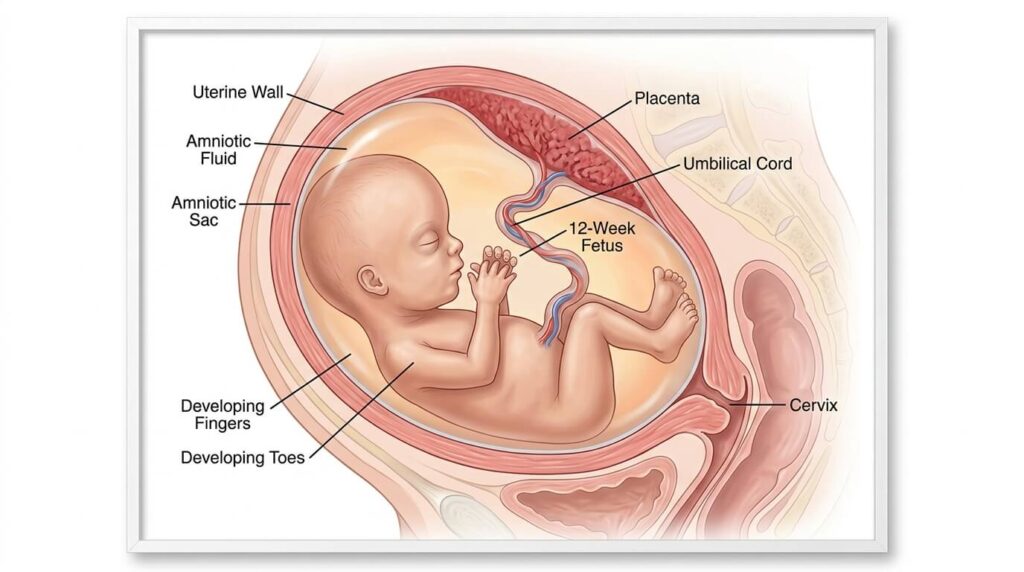
Reaching 12 weeks pregnant is one of the most emotionally significant milestones in the entire pregnancy journey. You’re wrapping up your first trimester, your miscarriage risk is dropping sharply, and your baby has gone from a cluster of cells to a fully-formed little human — complete with reflexes, fingernails, and a beating heart you may have already seen on a screen.
But this week can still feel complicated. Some symptoms are easing. Others — like headaches and round ligament pain — may just be starting. And if you haven’t had your 12-week scan yet, anticipation is probably running high.
This guide covers everything: every symptom you might experience, how your baby is developing, what happens at the nuchal translucency ultrasound, when to worry, and practical tips to help you feel your best as you head into the second trimester.
Where You Are: Week 12 at a Glance
At 12 weeks, you are in the final week of your first trimester. In terms of months, you are completing your third month of pregnancy. Your second trimester begins at week 13 (some providers say week 14).
| Milestone | Detail |
|---|---|
| Trimester | First (final week) |
| Month | 3rd month |
| Baby’s size | ~5.4 cm / 2.1 inches (crown to rump) |
| Baby’s weight | ~14 grams (0.5 oz) — about the size of a lime or plum |
| Miscarriage risk | Drops significantly this week |
| Key appointment | Nuchal translucency (NT) ultrasound scan |
12 Weeks Pregnant Symptoms
Every pregnancy is different, but the following symptoms are commonly reported during week 12. Some will begin fading; others may be just starting.
Morning Sickness and Nausea
For many pregnant people, nausea starts to ease around weeks 12–14. This is because the placenta is now taking over hormone production from the corpus luteum, stabilizing hCG levels — the hormone most strongly linked to pregnancy nausea. That said, some women continue experiencing morning sickness well into the second trimester, and that’s also completely normal.
What helps: Ginger tea, small frequent meals, vitamin B6 supplements (discuss with your provider), and staying hydrated.
Fatigue
Extreme tiredness is one of the hallmarks of the first trimester, driven by surging progesterone and the enormous energy demands of early fetal development. By week 12, many women report a gradual improvement — but it may not vanish overnight.
What helps: Rest when you can, light exercise (walking, prenatal yoga), and iron-rich foods if your levels are low.
Headaches and Dizziness
As nausea fades, headaches may move in. The culprits are increased blood volume, hormonal shifts, dehydration, and changes in blood pressure. Dizziness can also occur when standing up quickly (orthostatic hypotension).
What helps: Stay well-hydrated (aim for 8–10 glasses of water daily), avoid standing abruptly, eat regular meals to stabilize blood sugar, and rest in a cool environment.
When to worry: A severe, sudden headache — especially with visual disturbances, swelling, or high blood pressure — warrants an immediate call to your provider. It can occasionally signal preeclampsia, though this is rare in the first trimester.
Increased Vaginal Discharge (Leukorrhea)
A clear or milky-white vaginal discharge is entirely normal at 12 weeks. This is called leukorrhea, and it serves an important protective function: it helps guard the vaginal canal against infection as your cervix becomes more sensitive and vascular.
When to worry: Yellow, green, grey, or foul-smelling discharge; discharge accompanied by itching or burning; or any discharge that looks like blood (call your provider right away).

Breast Tenderness and Changes
Breast tenderness, sensitivity, and size changes are common throughout the first trimester. By week 12, you may also notice your areolas darkening and small bumps appearing around the nipple (Montgomery glands), which help with future breastfeeding. Many women find the tenderness starts to ease slightly by the end of the first trimester.
Bloating and Gas
Progesterone relaxes smooth muscle tissue — including the muscles of your digestive tract. This slows digestion, causing bloating, gas, and sometimes constipation. It’s one of the earliest and most persistent pregnancy symptoms.
What helps: Fiber-rich foods, prunes, plenty of water, gentle movement, and eating slowly.

Constipation
Closely related to bloating, constipation is extremely common in early pregnancy and can worsen if you’re taking iron supplements (which many prenatal vitamins contain). Don’t strain — that can aggravate hemorrhoids, which are another common pregnancy complaint.
What helps: Increase dietary fiber, drink plenty of fluids, exercise regularly, and ask your provider about a stool softener if needed.
Round Ligament Pain
The round ligaments support the uterus, and as it expands beyond your pelvic cavity around week 12, these ligaments can stretch and cause sharp, stabbing pains or a dull aching sensation — usually on one or both sides of the lower abdomen.
What helps: Change positions slowly, apply a warm compress, and try gentle stretching. If pain is severe or persistent, contact your provider.
Visible Veins
Increased blood volume (up to 50% more by the end of pregnancy) means your veins are working overtime. Blue or green veins may become more visible on your breasts, abdomen, and legs. This is normal and will gradually fade postpartum.

Mood Swings
Hormonal shifts, sleep disruption, and the emotional weight of early pregnancy can all contribute to mood swings, anxiety, and emotional sensitivity. This is normal — but if you’re feeling persistently low or overwhelmed, speak with your provider. Perinatal mental health support is important and widely available.
Food Aversions or Cravings
Many women notice new cravings (often for carbohydrates, salty foods, or citrus) and strong aversions (commonly to meat, fish, eggs, or coffee) during the first trimester. These tend to ease somewhat by 12 weeks as hormones stabilize.
Light Spotting
Light spotting can occur at 12 weeks, often because your cervix is more vascular and sensitive than usual. Spotting after sex or a pelvic exam is usually benign.
When to worry: Heavy bleeding, significant cramping, or passing tissue — call your provider or go to the emergency room immediately.
Symptoms That Are Easing vs. Starting
| Symptoms Usually Fading | Symptoms Possibly Beginning |
|---|---|
| Morning sickness / nausea | Headaches |
| Extreme fatigue | Dizziness |
| Food aversions | Round ligament pain |
| Breast tenderness | Visible veins |
| Heightened smell sensitivity | Pregnancy glow (skin changes) |
Your Baby at 12 Weeks: Development Milestones
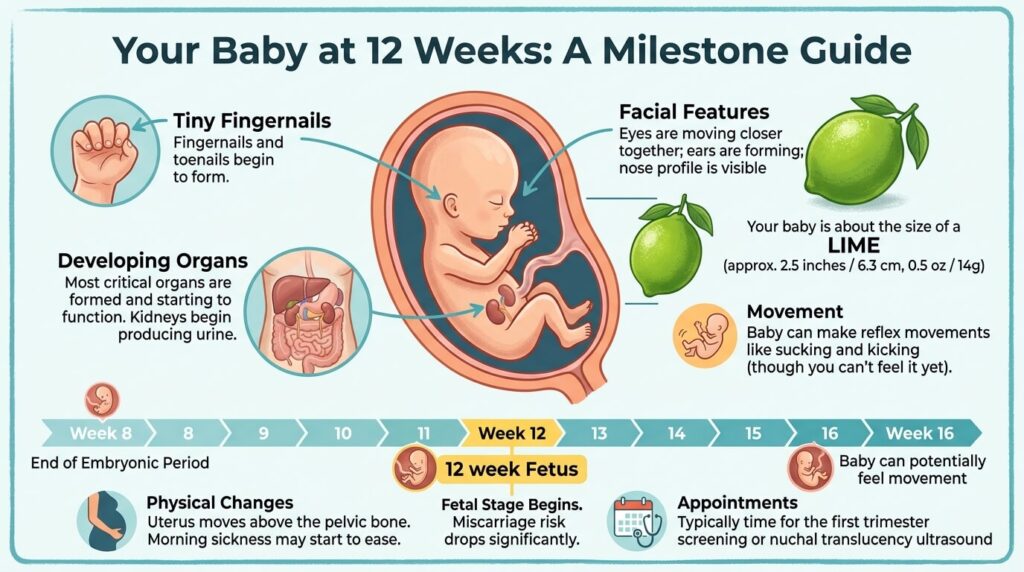
At 12 weeks, your baby is approximately 5.4 cm (2.1 inches) long from crown to rump and weighs around 14 grams (half an ounce) — roughly the size of a lime or small plum. In the past three weeks alone, your baby has more than doubled in size.
What’s Happening Inside
Reflexes are developing. The nervous system has matured enough to drive early involuntary responses. Your baby can now squint, open and close their fingers, make sucking motions, and respond to touch. If the sole of their foot were stimulated, their toes would curl.
The intestines have migrated. For the last few weeks, the intestines were partially developing within the umbilical cord — there simply wasn’t enough room in the tiny abdomen. By week 12, they have fully moved back into the abdominal cavity.
The kidneys are working. The urinary system is now functional; the kidneys are beginning to produce urine, which is released into the amniotic fluid.
Fingernails are forming. Tiny nail beds are developing on fingers and toes, and the webbing between the digits has fully disappeared.
Teeth buds are in place. All 20 baby teeth buds are now present in the gums, quietly waiting to emerge months after birth.
The bone marrow is producing white blood cells. This is the earliest foundation of the immune system.
The pituitary gland is active. The pituitary gland at the base of the brain has begun producing hormones, laying the groundwork for your baby’s entire endocrine system.
The placenta is fully functional. This is one of the most significant developments of week 12. The placenta has now taken over hormone production from the corpus luteum — this handover is the key reason why nausea often begins improving around this time.
External genitalia are present but sex may be hard to determine. The genitals have differentiated, but at 12 weeks, it’s often too early to reliably determine biological sex via ultrasound. A second-trimester anatomy scan (usually around 18–20 weeks) is more reliable.
The 12-Week Scan: Nuchal Translucency (NT) Ultrasound
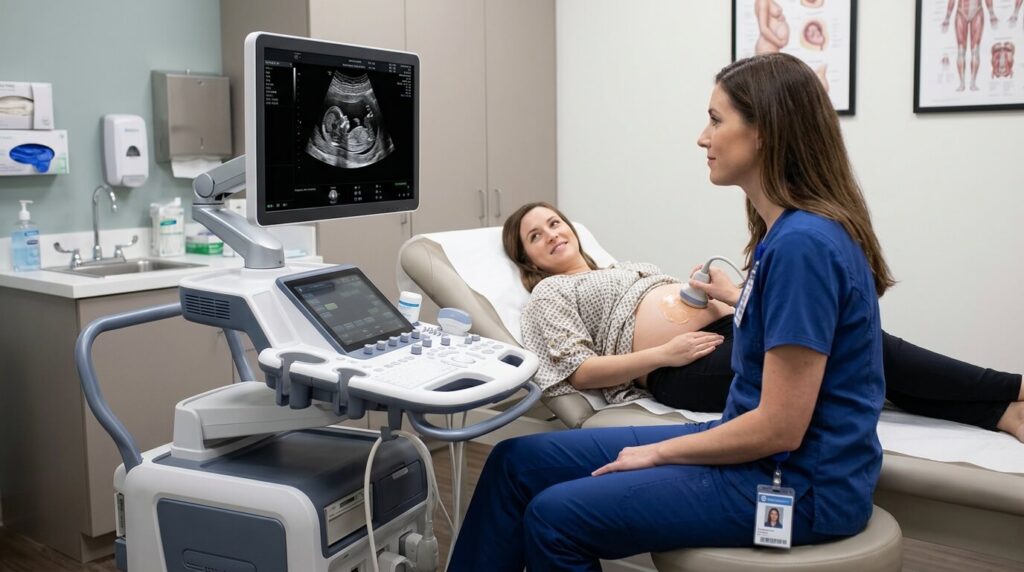
The 12-week scan — formally called the nuchal translucency (NT) scan — is typically the first major pregnancy ultrasound for most women and one of the most anticipated appointments of early pregnancy.
What Is the NT Scan?
The nuchal translucency scan is performed between 11 weeks 3 days and 14 weeks of pregnancy, with 12 weeks being the optimal window. It is an ultrasound examination that measures the fluid-filled space at the back of your baby’s neck, known as the nuchal fold. A small amount of fluid is entirely normal; it is present in all fetuses. However, excess fluid can indicate an increased risk of chromosomal abnormalities.
What the NT Scan Checks
- Nuchal translucency measurement — A normal NT is generally less than 3.5 mm. An NT of 3.5 mm or greater is considered elevated and may indicate a higher risk of chromosomal issues.
- Crown-rump length (CRL) — Confirms gestational age and due date.
- Viability — Confirms a heartbeat and that the pregnancy is progressing.
- Number of babies — Confirms if you’re carrying twins or multiples.
- Placenta position — Identifies placenta previa risk early.
- Fetal anatomy overview — Head, brain, face, heart, stomach, and limbs are assessed.
What the NT Scan Screens For
When combined with a blood test (measuring PAPP-A and free beta-hCG), the NT scan forms part of combined first-trimester screening. Together, these tests assess the risk of:
- Down syndrome (Trisomy 21)
- Edwards’ syndrome (Trisomy 18)
- Patau’s syndrome (Trisomy 13)
- Other structural abnormalities, including some heart defects
Important: The NT scan is a screening test, not a diagnostic test. An elevated NT does not confirm a chromosomal abnormality — it indicates an increased statistical risk. Diagnostic tests such as CVS (chorionic villus sampling) or amniocentesis are needed to confirm a diagnosis. A non-invasive alternative is NIPT (non-invasive prenatal testing), a blood test that analyses fetal DNA in maternal blood.
What Happens During the Scan
The scan is usually performed abdominally, though a transvaginal approach may occasionally be used for clearer images. You may be asked to have a full bladder beforehand. The sonographer will move a probe across your abdomen, capture measurements, and take images. The appointment typically lasts 20–30 minutes.
Understanding Your NT Results
| NT Measurement | Interpretation |
|---|---|
| Under 3.5 mm | Considered normal; lower chromosomal risk |
| 3.5 mm – 4.4 mm | Mildly increased; further testing usually recommended |
| 4.5 mm or above | Significantly increased; diagnostic testing strongly advised |
Note: Results are always interpreted alongside blood test markers and maternal age, not in isolation.
Miscarriage Risk at 12 Weeks
One of the most reassuring aspects of reaching week 12 is the dramatic reduction in miscarriage risk. Approximately 80% of all pregnancy losses occur during the first trimester. By week 13, the average risk of miscarriage falls to below 2.5%, compared to around 10–20% for the first trimester overall.
This drop occurs because:
- The most critical organ development has been completed
- The placenta has taken over and is functioning independently
- The embryonic period (highest risk of chromosomal and structural issues) has passed
This is why so many people choose week 12 — after their NT scan confirms a healthy heartbeat — as the moment to share their pregnancy news.
Your Body at 12 Weeks: Physical Changes
Uterus Size and Position
At 12 weeks, your uterus is approximately the size of a large grapefruit and is beginning to rise above the pelvic cavity. You may start to notice your lower abdomen feeling firmer. Your provider can often feel the top of the uterus (fundus) just above the pubic bone at this stage.
The Baby Bump at 12 Weeks
Some women are visibly showing at 12 weeks, particularly if it’s not their first pregnancy (the abdominal muscles have already stretched). Others won’t show until well into the second trimester. Both are entirely normal. Factors that affect bump visibility include: uterus position, body composition, number of previous pregnancies, and whether you’re carrying multiples.

Skin Changes
Some women experience the so-called “pregnancy glow” around this time — improved skin luminosity due to increased blood flow. Others experience breakouts, especially if they had acne before pregnancy. The linea nigra (a dark vertical line on the abdomen) may also begin to appear.
Weight Gain
By 12 weeks, healthy weight gain is typically 1–5 pounds for women who started at a normal BMI, though some lose weight due to morning sickness. Your provider will offer personalized guidance based on your pre-pregnancy weight and health. Total recommended weight gain for a singleton pregnancy at normal BMI is 25–35 pounds over the full pregnancy.
Prenatal Care at 12 Weeks: What to Expect at Your Appointment
If you haven’t already had a booking appointment (first prenatal visit), it may occur around this time. During a 12-week appointment, your provider may:
- Review your medical history and discuss risk factors
- Check blood pressure, weight, and urine (for protein, glucose, and signs of infection)
- Order or review blood tests: full blood count, blood group, rubella immunity, sexually transmitted infection screening (including HIV), thyroid function, and more
- Discuss or perform the NT scan (combined with blood tests for chromosomal screening)
- Listen for the fetal heartbeat using a Doppler device
- Discuss nutrition, supplements, and safe medications
- Answer your questions about exercise, travel, sex, and work
Nutrition and Diet at 12 Weeks
Good nutrition during pregnancy supports both your health and your baby’s development. Key nutritional priorities at 12 weeks:
Essential Nutrients
| Nutrient | Why It Matters | Sources |
|---|---|---|
| Folic acid / Folate | Prevents neural tube defects (most critical in weeks 1–12) | Leafy greens, legumes, fortified cereals |
| Iron | Supports increased blood volume; prevents anaemia | Red meat, lentils, tofu, fortified cereals |
| Calcium | Fetal bone and tooth development | Dairy, almonds, leafy greens |
| Omega-3 DHA | Fetal brain and eye development | Oily fish (low-mercury), walnuts, algae-based supplements |
| Vitamin D | Bone health, immune function | Sunlight, oily fish, fortified foods, supplements |
| Iodine | Thyroid function and fetal brain development | Seafood, dairy, iodized salt |
| Protein | Cell and tissue growth | Eggs, meat, legumes, dairy |
| Choline | Brain development | Eggs, beef, soybeans |
Foods to Avoid
- Raw or undercooked meat, poultry, and seafood (listeria, salmonella, toxoplasma risk)
- High-mercury fish: swordfish, shark, king mackerel, tilefish, bigeye tuna
- Unpasteurised dairy and soft cheeses: brie, camembert, blue cheese
- Raw sprouts
- Unwashed fruits and vegetables
- Excessive caffeine (limit to 200 mg/day — roughly one 12 oz coffee)
- Alcohol: no safe amount has been established in pregnancy
- Liver and pâté (very high in vitamin A, which can be harmful in excess)
Exercise at 12 Weeks Pregnant
Regular, moderate exercise during pregnancy offers well-documented benefits, including better weight management, reduced risk of gestational diabetes, improved mood, easier labor, and faster postpartum recovery. With improving energy levels around week 12, now is a great time to establish or maintain an exercise routine.
Safe Exercises at 12 Weeks
- Walking — One of the best and most accessible forms of prenatal exercise
- Swimming and water aerobics — Low impact, reduces joint strain, relieves swelling
- Prenatal yoga — Improves flexibility, reduces stress, supports pelvic floor
- Stationary cycling — Safe cardio with no fall risk
- Light strength training — Maintain muscle tone with lighter weights and more reps
Exercises to Avoid
- Contact sports or activities with high fall risk
- Exercises requiring you to lie flat on your back for extended periods (after the first trimester, this can compress the vena cava)
- High-altitude activities
- Scuba diving
- Exercises that feel painful or cause dizziness
Always consult your provider before starting or changing any exercise routine during pregnancy.
Mental Health and Emotional Wellbeing at 12 Weeks
Pregnancy is emotionally complex. Even when things are going well, anxiety, stress, and emotional volatility are extremely common — particularly in the first trimester as you navigate uncertainty, physical discomfort, and major life change.

Common Emotional Experiences at 12 Weeks
- Anxiety about the NT scan and what the results might show
- Excitement as the miscarriage risk drops and pregnancy feels more “real”
- Relief that some physical symptoms are easing
- Worry about becoming a parent, finances, or relationship changes
- Mood swings driven by hormonal fluctuations
When to Seek Support
If you are experiencing persistent sadness, inability to function day-to-day, panic attacks, or thoughts of self-harm, please speak with your provider or midwife. Perinatal depression and anxiety affect up to 1 in 5 pregnant women and are highly treatable. You don’t have to white-knuckle through it.
Announcing Your Pregnancy at 12 Weeks
The 12-week mark is the most popular time to announce a pregnancy, and for good reason: the risk of miscarriage drops sharply, the NT scan provides reassurance, and the first trimester symptoms are beginning to ease. That said, there is no right or wrong time to share your news. Some people tell family and close friends earlier; others wait until the anatomy scan at 20 weeks.
Workplace Considerations
You are not legally required to inform your employer of your pregnancy at 12 weeks in most jurisdictions. However, if your job involves physical labor, chemical exposure, heavy lifting, or other potential risks, informing your employer sooner allows them to carry out a risk assessment and adjust your duties accordingly.
What to Avoid at 12 Weeks Pregnant
| Avoid | Reason |
|---|---|
| Alcohol | No safe limit established; linked to fetal alcohol spectrum disorders |
| Smoking | Associated with low birth weight, preterm birth, miscarriage |
| Recreational drugs | Wide range of developmental harms |
| Hot tubs and saunas | Overheating can affect fetal development |
| Certain medications | Always check with your provider before taking anything new |
| Excessive vitamin A | Can cause birth defects at high doses |
| High-mercury fish | Mercury accumulates and can harm the fetal nervous system |
| Stress and sleep deprivation | Linked to pregnancy complications; prioritize rest |
Warning Signs at 12 Weeks: When to Call Your Doctor
While most 12-week pregnancies progress without complication, certain symptoms require immediate medical attention:
🚨 Call your provider immediately if you experience:
- Heavy vaginal bleeding (more than spotting)
- Severe abdominal pain or cramping that doesn’t ease
- Fever above 38°C / 100.4°F
- A sudden, severe headache with visual changes or swelling (possible preeclampsia)
- Burning or pain with urination (possible UTI, which can trigger preterm labor if untreated)
- Significant reduction in typical symptoms (especially if you had severe morning sickness that abruptly stops)
- Sudden swelling of hands, feet, or face
Twins at 12 Weeks
If you’re carrying twins or multiples, you will likely have already been informed. At 12 weeks, your symptoms may be more pronounced — higher hCG levels in a twin pregnancy often mean more intense morning sickness, more fatigue, and a larger, earlier-showing bump. Your prenatal care schedule will be more frequent, and you may be referred to a maternal-fetal medicine specialist depending on whether your twins are identical (monochorionic) or fraternal (dichorionic).
Frequently Asked Questions (FAQ)
1. Is 12 weeks the end of the first trimester?
Yes. Most medical guidelines define the first trimester as weeks 1–12, with the second trimester beginning at week 13. Some providers extend the first trimester to week 14; ask your provider which definition they use.
2. Is it normal to not be showing at 12 weeks?
Absolutely. Many first-time pregnant women don’t show noticeably until 14–20 weeks. Body type, uterus position, and abdominal muscle tone all affect when a bump becomes visible.
3. Can I find out the baby’s sex at 12 weeks?
Biological sex can sometimes be inferred from the angle of the genital tubercle on a 12-week scan, but it’s not reliable. NIPT blood tests (available from week 10) can determine chromosomal sex with high accuracy. The anatomy scan at 18–20 weeks is the standard method.
4. Is morning sickness supposed to stop at 12 weeks?
For many people, nausea begins improving around weeks 12–14 as hCG levels stabilize and the placenta takes over. However, some women experience nausea throughout pregnancy — this is normal and not a sign that something is wrong.
5. What does the baby look like at 12 weeks?
At 12 weeks, your baby is unmistakably human. They have a defined head (still disproportionately large), facial features including eyes, nose, and forming ears, tiny fingers and toes, and a beating heart. Their skin is still thin and translucent.

6. Is cramping normal at 12 weeks?
Mild cramping can occur due to round ligament stretching as the uterus grows. However, severe cramping — especially with bleeding — should be evaluated by your provider immediately.
7. Can I have sex at 12 weeks pregnant?
For most uncomplicated pregnancies, sex is completely safe throughout pregnancy. Your provider may advise against it in specific circumstances (such as placenta previa, cervical incompetence, or risk of preterm labor). Light spotting after sex is common and usually benign but should be mentioned to your provider.
8. What tests are done at 12 weeks?
The main screening at 12 weeks is the nuchal translucency (NT) ultrasound, combined with blood tests measuring PAPP-A and free beta-hCG. Together, these form the combined first-trimester screening for chromosomal conditions. Some providers also offer NIPT at this stage.
9. How much weight should I have gained by 12 weeks?
Weight gain varies widely. Women who start at a normal BMI typically gain 1–5 pounds in the first trimester; some lose weight due to morning sickness. Your provider will guide you based on your individual circumstances.
10. Is it safe to travel at 12 weeks?
Generally yes, for most uncomplicated pregnancies. The second trimester (weeks 13–28) is often considered the ideal travel window. If flying, stay hydrated, move regularly to reduce DVT risk, and wear compression socks on longer flights.

11. Why am I still so tired at 12 weeks?
Fatigue can persist beyond the first trimester for many women. Your body is still doing enormous work — growing a placenta, increasing blood volume, and sustaining a developing fetus. Anaemia (low iron) can also cause fatigue; a blood test can rule this out.
12. Can I use a Doppler at home at 12 weeks?
Home fetal Dopplers can sometimes detect a heartbeat at 12 weeks, but it’s not guaranteed — the baby’s position, your body type, and device quality all affect results. Failure to find a heartbeat at home does not mean something is wrong. Home Dopplers should not replace professional monitoring or be used to reassure yourself in the event of concerning symptoms.
13. What should I eat at 12 weeks pregnant?
Focus on a balanced diet rich in folate, iron, calcium, protein, and omega-3 fatty acids. Include plenty of fruits, vegetables, whole grains, lean proteins, and dairy or dairy alternatives. Avoid high-mercury fish, raw or undercooked meat and eggs, unpasteurised dairy, and alcohol.
14. Is the 12-week scan painful?
No. The NT scan is a non-invasive ultrasound performed abdominally. It involves gel on your stomach and a probe moved over the abdomen. It is not painful, though you may experience mild pressure. In some cases, a transvaginal probe may be used for a clearer image, which may feel slightly uncomfortable but is not harmful.
15. When should I announce my pregnancy?
There is no perfect time — it’s a personal decision. Many people choose week 12 because the miscarriage risk has dropped significantly after the NT scan. Others wait until the anatomy scan at 20 weeks, or tell close family earlier.