
Learn exactly how to calculate when your next period is using simple math, cycle tracking methods, and expert tips. You’re standing in the pharmacy aisle, trying to remember when your last period started. Or maybe you have a beach trip coming up and really, really need to know if your period will crash it. Sound familiar? Check your next period date in free with our free period calculator.
Figuring out how to calculate when your next period is one of the most common health questions people have — and yet, most articles give you a calculator widget and not much else. This guide goes deeper. You’ll understand the why behind the math, what to do when your cycle is irregular, how hormones affect your predictions, and when a “late” period actually means something.
Let’s start from the beginning.
What Is a Menstrual Cycle, Really?
Before you can predict your next period, it helps to understand what you’re actually tracking.
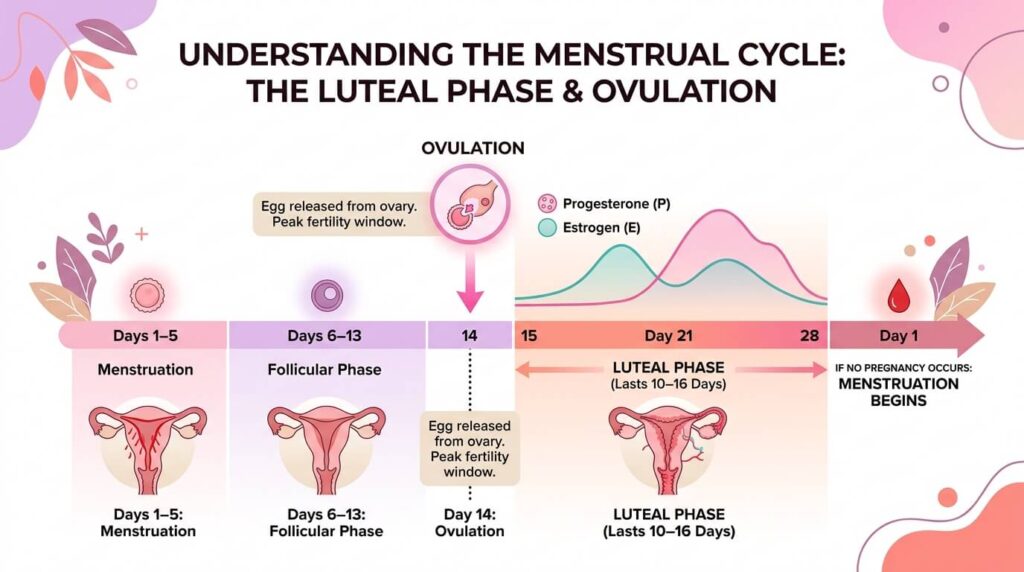
Your menstrual cycle is the monthly hormonal process your body goes through to prepare for a possible pregnancy. Day 1 is the first day of your period (not spotting — actual bleeding). The cycle ends the day before your next period begins.
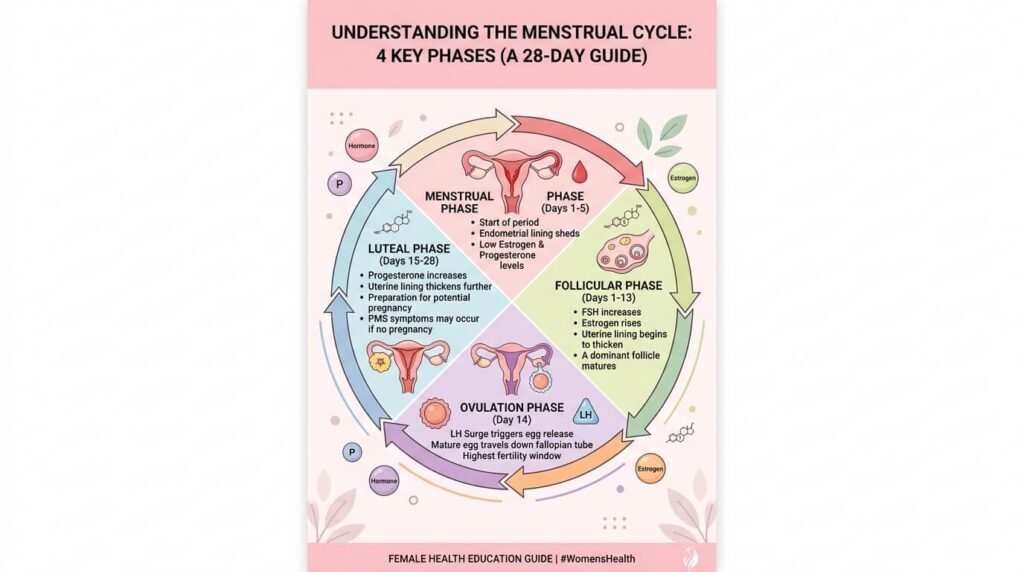
The four phases are:
- Menstrual phase — your period (days 1–5 on average)
- Follicular phase — your body prepares to release an egg (days 1–13)
- Ovulation — egg release, usually around day 14 in a 28-day cycle
- Luteal phase — post-ovulation; if no pregnancy occurs, menstruation begins (days 15–28)
Most people think of their “cycle” as just their period. But your period is only one part of a much more dynamic monthly process.
The Simple Formula: How to Calculate When Your Next Period Is
Here’s the core math. It’s straightforward once you know two things:
- The first day of your last period
- Your average cycle length
Formula:
First day of last period + Average cycle length = Estimated start of next period
Example:
- Last period started: June 1
- Average cycle length: 28 days
- Next period: June 1 + 28 = June 29
That’s it. No app required — just a calendar and two numbers.
What If You Don’t Know Your Average Cycle Length?
The average cycle length is 28 days, but “average” is misleading. The American College of Obstetricians and Gynecologists (ACOG) considers anything between 21 and 35 days to be within the normal range. That’s a 14-day window of completely normal variation.
To find your actual average:
- Track the first day of your period for 3–6 months
- Count the number of days between each period start date
- Add those numbers together and divide by the number of cycles tracked
Example:
- Cycle 1: 29 days
- Cycle 2: 27 days
- Cycle 3: 30 days
- Average: (29 + 27 + 30) ÷ 3 = 28.7 days → round to 29
Use that personal average — not the generic 28-day default — for more accurate predictions.
How to Calculate Your Next Period Manually (Step-by-Step)
No app? No problem. Here’s how to do it the old-fashioned way.
What you need:
- A calendar (paper or digital)
- The date your last period started
- Your estimated cycle length (use 28 if unsure)
Step 1: Mark the first day of your last period on the calendar. Label it “Day 1.”
Step 2: Count forward by your cycle length. If your cycle is 28 days, count 28 days forward from Day 1.
Step 3: The day you land on is your estimated next period start date. Circle it.
Step 4: To give yourself a buffer zone, also circle the two days before and after that date — your period could realistically fall anywhere in that 5-day window.
Pro tip: Do this for the next 3 months at once so you can plan ahead for travel, events, or stressful weeks.
Understanding Cycle Length: Why It Changes Month to Month
Here’s something most period calculators won’t tell you: your cycle length is not fixed. It fluctuates — sometimes by several days — and that’s completely normal.
Common Reasons Your Cycle Length Changes
Stress — One of the biggest disruptors. High cortisol levels can delay ovulation, which pushes your whole cycle back. A stressful month can make your period arrive 5–10 days late.
Travel and time zone changes — Jet lag doesn’t just affect your sleep. Disrupting your circadian rhythm can shift your hormonal timing, especially around ovulation.
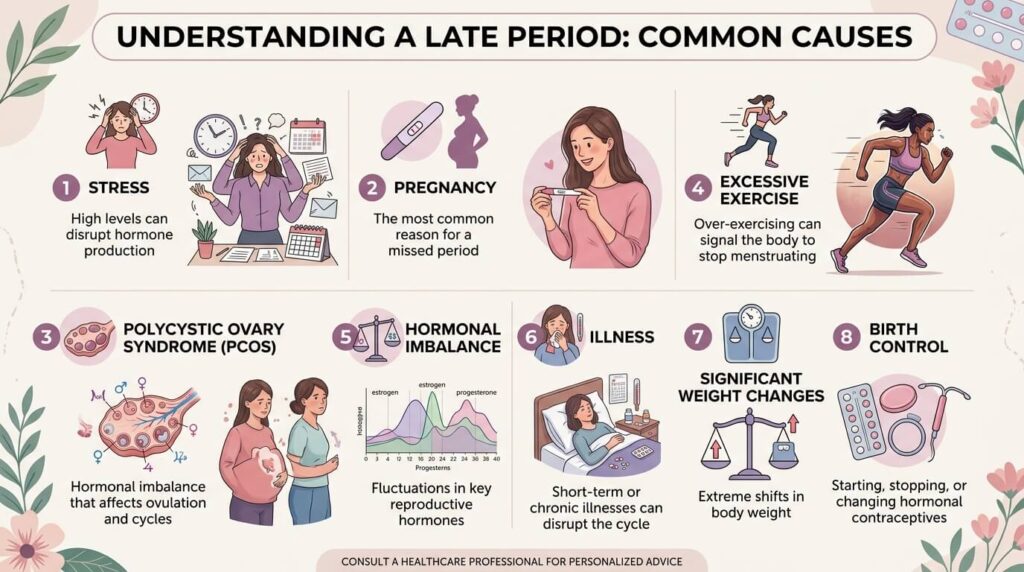
Illness or fever — Being sick, especially with a high fever, can delay ovulation temporarily.
Significant weight changes — Both rapid weight loss and weight gain affect estrogen production, which directly impacts cycle regularity.
Exercise intensity — Extreme training loads (marathon prep, intense CrossFit phases) can suppress ovulation in some people through a process called hypothalamic amenorrhea.
Hormonal birth control — Starting, stopping, or switching contraceptives can make cycles unpredictable for several months while your body recalibrates.
Perimenopause — In your 40s (and sometimes late 30s), cycles often become shorter, then more irregular, as ovarian reserve declines.
Understanding why your cycle changed is just as useful as knowing when your next period might arrive.
How to Calculate Your Period If Your Cycle Is Irregular
This is where the standard “28-day calculator” completely falls apart — and where most articles leave you hanging.
If your cycles vary by more than 7–9 days from month to month, you have what’s considered an irregular cycle. Calculating your next period isn’t impossible; you just need a different approach.
Method 1: Use a Range, Not a Single Date
Instead of predicting one day, predict a window.
- Find your shortest recent cycle (say, 24 days)
- Find your longest recent cycle (say, 35 days)
- Your next period is likely to arrive somewhere between Day 24 and Day 35 after your last period started
This gives you a realistic range to watch for, rather than one date that may be wrong.

Method 2: Track Ovulation Signs
Ovulation always happens roughly 12–16 days before your next period — this is called the luteal phase, and it’s actually the more consistent part of your cycle. If you can identify when you ovulate, you can count backward.
Signs of ovulation include:
- Clear, stretchy cervical mucus (like raw egg white)
- A slight rise in basal body temperature (0.2–0.5°C)
- Mild one-sided pelvic cramping (mittelschmerz)
- Increased libido
- A positive result on an ovulation predictor kit (OPK)
If you notice these signs, expect your period approximately 12–14 days later.
Method 3: The “Shortest Cycle Minus 18” Rule
This is commonly used for identifying your fertile window, but it also helps with planning. Subtract 18 from your shortest cycle to find the earliest your period might arrive. Subtract 11 from your longest cycle for the latest.
The Luteal Phase: The Key to More Accurate Predictions
Most people focus on when they ovulate, but the real prediction anchor is your luteal phase — the time between ovulation and menstruation.
Unlike the follicular phase (which varies widely), the luteal phase is relatively stable at 12–14 days for most people. This means:
- If you ovulate on Day 12 of your cycle, expect your period around Day 26
- If you ovulate on Day 18, expect your period around Day 32
A luteal phase shorter than 10 days (called luteal phase defect) can cause very early periods and is sometimes linked to fertility challenges — worth mentioning to a gynecologist if you notice this pattern.
How Many Days Late Is “Late”?
This is one of the most searched questions related to period prediction, and the answer requires context.
A period is generally considered late if it hasn’t arrived within 7 days of the expected date based on your usual cycle. But “late” is relative:
- If your cycle is usually 28 days and it’s been 35 days — that’s late.
- If your cycle normally ranges from 26 to 33 days, Day 33 is not late — it’s within your personal range.
A period is considered missed if it hasn’t arrived after 35+ days from the start of your last period.
Common reasons for a late period (besides pregnancy):
- Stress (emotional or physical)
- Thyroid dysfunction (both hypo- and hyperthyroidism)
- Polycystic ovary syndrome (PCOS)
- Sudden changes in diet or weight
- Excessive exercise
- Certain medications (antidepressants, antipsychotics, steroids)
- Breastfeeding (prolactin suppresses ovulation)
If your period is more than two weeks late and a pregnancy test is negative, it’s worth talking to a healthcare provider.
Calculating Your Period Around Specific Events
Here’s the practical stuff — because sometimes you just need to know if your period will show up during your wedding, vacation, or exam week.
Planning Around a Holiday or Event
- Calculate your estimated next period date using the formula above
- If your period is expected to fall within 3 days of your event, plan for supplies
- If needed, talk to your doctor about hormonal options to delay your period (this is safe for most people and is typically done with norethisterone or combined contraceptive pills)
Calculating Backwards from an Event
Want to know if you’ll have your period during an event 6 weeks away?
- Note today’s date and the event date
- Calculate how many days away the event is
- Divide that by your average cycle length to see how many cycles fall in between
- Use the formula to project 2–3 cycle start dates and see if one lands near your event
Period Prediction and Fertility: What’s the Connection?
Understanding how to calculate your next period also unlocks insight into your fertile window — which matters whether you’re trying to conceive or trying to avoid pregnancy.
Your most fertile days are typically:
- 5 days before ovulation
- The day of ovulation itself
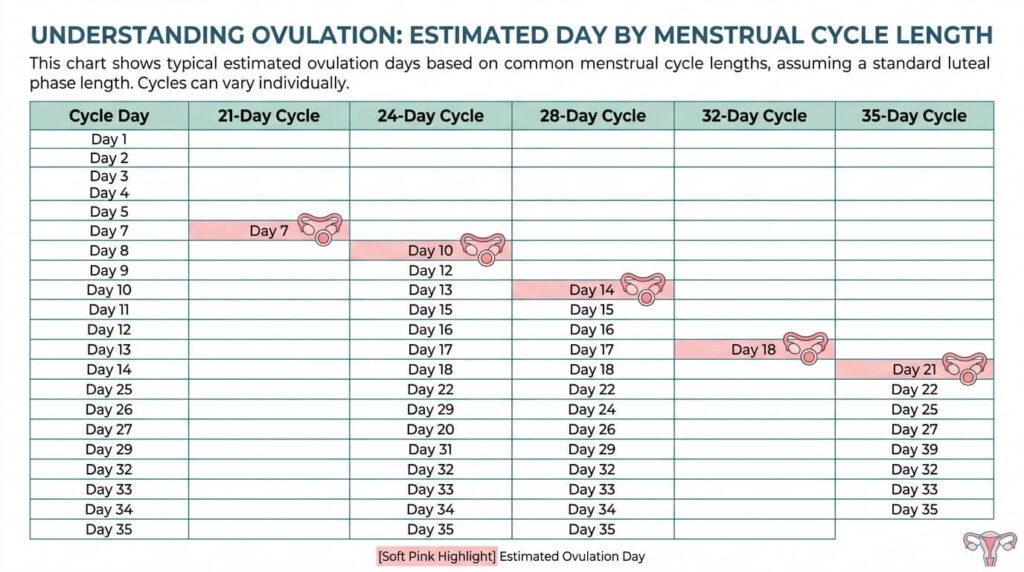
In a 28-day cycle, ovulation usually falls around Day 14, making Days 9–14 the primary fertile window. But this shifts with your cycle length:
| Cycle Length | Estimated Ovulation Day | Fertile Window |
|---|---|---|
| 21 days | Day 7 | Days 2–7 |
| 24 days | Day 10 | Days 5–10 |
| 28 days | Day 14 | Days 9–14 |
| 32 days | Day 18 | Days 13–18 |
| 35 days | Day 21 | Days 16–21 |
Note: These are estimates. Ovulation can vary, and the only reliable way to confirm it is through BBT charting, OPKs, or ultrasound monitoring.
Common Mistakes People Make When Tracking Their Period
Even people who’ve been menstruating for years make these errors.
Mistake 1: Starting the count from the wrong day The cycle starts on Day 1 of actual bleeding, not spotting. Light pink or brown discharge the day before your full flow is not Day 1.
Mistake 2: Using a generic 28-day cycle Your cycle length is personal. Using someone else’s average will throw off your predictions by days or even weeks.
Mistake 3: Assuming every cycle will be the same Life happens. Stress, illness, travel — all of these shift cycle length. Build in a 3–5 day buffer when planning.
Mistake 4: Confusing cycle length with period length Your cycle is the time between period start dates. Your period is just the bleeding part (typically 3–7 days). These are different measurements.
Mistake 5: Panicking at the first “late” day One or two days’ variation is meaningless. A true late period starts at 7+ days beyond your expected date.
Mistake 6: Ignoring pattern changes If your cycle suddenly shortens or lengthens by 7+ days with no obvious lifestyle reason, that’s worth tracking and potentially discussing with a doctor.
When to See a Doctor About Your Period
Period prediction tools are useful, but they’re not a substitute for medical attention. Talk to a gynecologist or GP if you notice:
- No period for 3+ months (amenorrhea) and you’re not pregnant or breastfeeding
- Extremely heavy bleeding (soaking a pad or tampon every hour for 2+ hours)
- Severe cramping that doesn’t respond to over-the-counter pain relief
- Periods that last longer than 7 days
- Spotting between periods or after sex
- Sudden significant changes in cycle length without an obvious cause
- Signs of PCOS (irregular periods, excess hair growth, acne, weight changes)
These are all scenarios where tracking data — dates, flow, symptoms — becomes genuinely useful to share with a clinician.
Tools and Methods for Tracking Your Cycle
You have several options, from low-tech to high-tech.
Paper calendar or diary — Simple and private. Note the first day of each period and count from there. Works perfectly for regular cycles.
Spreadsheet — Calculate your average cycle length, create formulas to predict the next 6 months, and track flow and symptoms in columns.
Period tracking apps — Apps use your input data to refine predictions over time. Look for apps that let you export data (useful for medical appointments).
Basal body temperature (BBT) charting — Taking your temperature every morning before getting out of bed and logging it can reveal your ovulation pattern. Requires consistency.
Ovulation predictor kits (OPKs) — Urine-based tests that detect the LH surge before ovulation. Combined with period tracking, these give you a much clearer picture.
Wearable devices — Some devices (like certain smartwatches) now offer cycle tracking features based on temperature and heart rate data.
No method is 100% accurate because biology isn’t mechanical — but combining 2–3 tracking methods gives you the best predictions.
How Hormonal Contraception Changes Everything
If you’re on hormonal birth control, standard cycle math mostly doesn’t apply — and this confuses a lot of people.
Combined oral contraceptive pill (OCP): You’ll typically bleed during the 7 placebo pills (or pill-free week). This is a withdrawal bleed, not a true period. Your cycle is controlled by the pill, not by ovulation.
Progestin-only pill (mini-pill): Cycles can be unpredictable. Some people have light irregular bleeding; others stop bleeding altogether.
IUDs: Hormonal IUDs (like Mirena) often cause periods to become lighter and shorter, or stop altogether. Copper IUDs may make periods heavier and more crampy.
Implant (Nexplanon) and injection (Depo-Provera): Highly variable. Many people experience irregular spotting, especially in the first 3–6 months.
After stopping hormonal contraception, it can take 1–3 months (sometimes longer) for your natural cycle to fully re-establish.
Period Tracking for Teens: What’s Normal?
If you’re tracking periods for yourself or a young person who has recently started menstruating, here’s what to know.
In the first 1–3 years after your first period (menarche), irregular cycles are completely normal. The hypothalamic-pituitary-ovarian (HPO) axis — the hormonal feedback system that regulates cycles — takes time to mature.
Cycle lengths in early menstruation can range widely from month to month. What you’re looking for is a gradual trend toward more regularity over time — not immediate clockwork precision.
Conclusion: Take Control of Your Cycle Tracking
Learning how to calculate when your next period is gives you something genuinely powerful — body literacy. When you understand your cycle, you can plan better, spot irregularities earlier, and have more informed conversations with healthcare providers.
The formula is simple: first day of last period + average cycle length = next period estimate. But the real skill is knowing your average, understanding the factors that shift it, and building in appropriate buffers for the unpredictability that’s part of every normal cycle.
Start tracking today — even if it’s just noting the start date in your phone’s calendar. After 3–4 months, you’ll have enough data to make genuinely accurate predictions and spot any patterns worth paying attention to.
Your cycle is one of the most consistent health signals your body produces. It’s worth understanding.
Frequently Asked Questions (FAQ)
Q: How do I calculate when my next period will start? Add your average cycle length to the first day of your last period. For example, if your last period began on the 5th and your cycle is 28 days, your next period is expected around the 2nd of the following month.
Q: What is a normal cycle length? According to ACOG, a cycle length between 21 and 35 days is within the normal range. The commonly cited “28 days” is an average, not a standard.
Q: How can I predict my period if my cycle is irregular? Track your 3–6 most recent cycles, identify your shortest and longest cycle lengths, and use that range as your prediction window. Also consider tracking ovulation signs — your period typically arrives 12–14 days after ovulation regardless of cycle length.
Q: How many days late is considered a missed period? A period is generally considered late if it hasn’t arrived 7 days after your expected date. A missed period is typically defined as no period for 35+ days since your last one, or no period for 3 consecutive months.
Q: Can stress really delay my period? Yes. Psychological and physical stress raises cortisol levels, which can suppress GnRH (gonadotropin-releasing hormone), delaying or even preventing ovulation. This directly shifts your period start date.
Q: Does ovulation always happen on Day 14? No. Day 14 is an estimate based on a textbook 28-day cycle. Ovulation day varies based on your actual cycle length. In a 24-day cycle, ovulation may occur around Day 10. In a 32-day cycle, it may be closer to Day 18.

Q: Can I predict my period without an app? Absolutely. A simple calendar and the formula (last period start + cycle length) is all you need. Apps add convenience and pattern analysis, but are not required.
Q: How does the luteal phase affect period prediction? The luteal phase (time from ovulation to period) is relatively fixed at 12–14 days for most people. If you can identify when you ovulate, counting 14 days forward gives you a reliable period estimate regardless of cycle length.
Q: Should I be worried if my cycle length changes month to month? Minor variation (1–3 days) is normal. Variation of 7+ days is worth monitoring. If your cycles are consistently outside the 21–35 day range or changing dramatically without a clear cause, consult a healthcare provider.
Q: What if my period doesn’t come but the pregnancy test is negative? Wait a few days and retest. If still negative and your period is 2+ weeks late, see a doctor — thyroid issues, PCOS, extreme stress, or other hormonal imbalances can cause missed periods unrelated to pregnancy.