If you’ve ever been handed an antibiotic prescription while on the pill, patch, ring, IUD, implant, or shot, you’ve probably had the same thought: wait, does this cancel out my birth control? It’s one of the most persistent myths in reproductive health, and it’s repeated so often — by well-meaning friends, old pharmacy labels, even some clinicians — that it’s hard to know what’s actually true.
Here’s the short version: for the overwhelming majority of antibiotics, the answer is no. Decades of pharmacology research and current guidance from the American College of Obstetricians and Gynecologists (ACOG) and the CDC point to one real exception — the rifamycin class (rifampin and rifabutin) — with a small handful of other antibiotics carrying weaker, mostly historical evidence of an effect. This guide breaks down exactly which antibiotics matter, why the myth became so widespread in the first place, how each birth control method is affected differently, and what to actually do if you’re prescribed antibiotics while using contraception.
Quick Answer: Does Amoxicillin Affect Birth Control?
No. Amoxicillin — one of the most commonly prescribed antibiotics for ear infections, sinus infections, UTIs, and dental infections — has not been shown in controlled studies to reduce the effectiveness of hormonal birth control. Older case reports from the 1970s–1990s raised concern, but more rigorous pharmacokinetic studies since then have not confirmed a clinically meaningful interaction. You do not need backup contraception solely because you’re taking amoxicillin.
How Hormonal Birth Control Actually Works
Most hormonal contraceptives — the combined pill, the patch, the vaginal ring, the minipill, the implant, the shot, and hormonal IUDs — work by releasing synthetic estrogen and/or progestin into the bloodstream. These hormones:
- Suppress ovulation (prevent the ovary from releasing an egg)
- Thicken cervical mucus to block sperm
- Thin the uterine lining to make implantation less likely
For the hormones to work, they need to maintain a steady, predictable level in the blood. Anything that meaningfully speeds up how the liver breaks down those hormones — or interferes with how they’re absorbed — can, in theory, lower hormone levels enough to reduce effectiveness.
The Liver Enzyme Connection: Cytochrome P450
The liver metabolizes estrogen primarily through an enzyme system called cytochrome P450 3A4 (CYP3A4). Some drugs are “enzyme inducers” — they ramp up CYP3A4 activity, which metabolizes hormones faster and lowers the amount circulating in the blood. This is the well-established mechanism behind rifampin’s effect on birth control. It’s also why certain anti-seizure medications and HIV medications carry similar warnings.
The Gut Bacteria Theory (Older, Less Supported)
The original theory behind antibiotics like penicillins and tetracyclines was different: it proposed that these drugs disrupt gut bacteria responsible for recycling estrogen through a process called enterohepatic circulation. Killing off those bacteria, the theory went, would mean less estrogen gets reabsorbed and more gets excreted, lowering blood levels. This mechanism made biological sense and led to decades of caution around common antibiotics. However, follow-up pharmacokinetic studies in the 1980s and 1990s largely failed to detect a significant drop in hormone levels with most antibiotics in this category, which is why current major guidelines no longer recommend routine backup contraception for them.

The One Antibiotic Class That Matters: Rifamycins
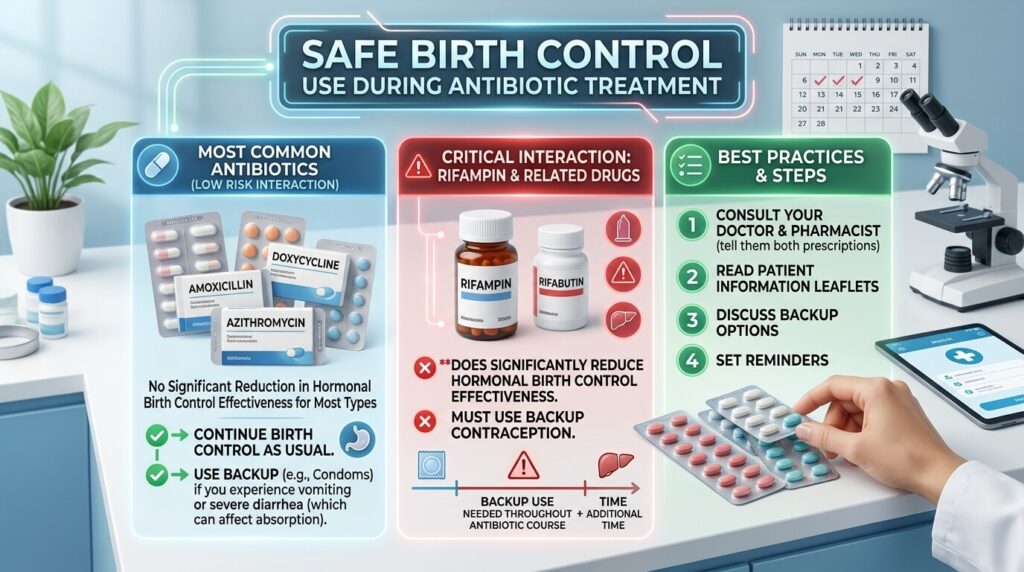
Rifampin (brand names Rifadin, Rimactane) and its relative rifabutin are the only antibiotics with strong, reproducible evidence of reducing hormonal birth control effectiveness. They are potent CYP3A4 inducers, increasing estrogen metabolism several-fold.
- Used for: Tuberculosis, certain types of meningitis exposure prophylaxis, and some other less common bacterial infections
- Effect: Significantly reduces estrogen and progestin levels, increasing breakthrough bleeding and pregnancy risk
- What to do: Use a backup non-hormonal method (condoms, copper IUD) during treatment and for at least 28 days after stopping rifampin, per current clinical guidance — and discuss your specific contraception with your provider, since this duration can vary by source
If you’re prescribed rifampin or rifabutin for any reason, tell your prescriber and your contraception provider, even if they’re different people. This is the one interaction that’s not controversial.
Antibiotics Often Blamed But Not Currently Supported by Evidence
This is where most consumer confusion lives, and where competitor articles often give outdated or inconsistent guidance. Below is a clear breakdown by antibiotic class.
Amoxicillin, Ampicillin, and Other Penicillins
Implicated in older case reports, but larger pharmacokinetic studies have not confirmed a consistent drop in hormone levels. Current major guidance does not recommend backup contraception for penicillin-class antibiotics.
Doxycycline and Other Tetracyclines
This is one of the most commonly repeated myths, including on other websites covering this exact topic. Despite the persistent claim that doxycycline reduces birth control effectiveness, current evidence and major guidelines do not support this as a clinically significant interaction for most patients. A controlled study of tetracycline combined with oral contraceptives found no statistically significant change in hormone levels. If you see a website or pharmacy handout claiming otherwise, it’s likely repeating an older, unconfirmed assumption rather than current evidence.
Metronidazole
Frequently prescribed for bacterial vaginosis and certain dental or GI infections. Historical case reports exist, but they are sparse, and metronidazole is generally not considered to meaningfully interact with hormonal contraception.
Azithromycin, Erythromycin, and Other Macrolides
Limited and inconsistent evidence of any interaction. Not currently flagged as a significant concern.
Ciprofloxacin and Other Fluoroquinolones
No meaningful evidence of reduced contraceptive efficacy.
Cephalosporins (e.g., Cephalexin)
Rare, isolated case reports only; not considered clinically significant.
Griseofulvin (Antifungal, Not Technically an Antibiotic but Often Grouped With Them)
This one deserves a specific mention because it’s sometimes lumped in with “antibiotics” in older literature. Griseofulvin is an antifungal that induces liver enzymes similarly to rifampin, and several case reports link it to contraceptive failure. Some clinicians still recommend backup contraception with griseofulvin out of caution, even though the overall evidence base is smaller than for rifampin.
Co-trimoxazole (Trimethoprim/Sulfamethoxazole)
Interestingly, some research suggests this combination may slightly increase circulating estrogen levels by inhibiting its breakdown — the opposite of a typical concern, though it has also been linked to isolated pregnancy case reports historically.
Comparison Table: Antibiotic Risk Categories for Hormonal Birth Control
| Antibiotic / Drug Class | Current Evidence of Interaction | Backup Contraception Recommended? |
|---|---|---|
| Rifampin, Rifabutin | Strong, well-established (CYP3A4 induction) | Yes — during treatment + at least 28 days after |
| Griseofulvin (antifungal) | Moderate, older case reports | Some clinicians recommend caution |
| Amoxicillin, Ampicillin | Weak / not confirmed in modern studies | No |
| Doxycycline, Tetracycline | Weak / not confirmed; commonly mythologized | No |
| Metronidazole | Sparse, isolated case reports | No |
| Azithromycin, Erythromycin | Minimal evidence | No |
| Ciprofloxacin | No significant evidence | No |
| Cephalexin (cephalosporins) | Rare isolated reports | No |
| Co-trimoxazole | Mixed; may increase estrogen levels | Generally no |
Does the Type of Birth Control Method Change the Risk?
Not all hormonal contraception behaves the same way when it comes to drug interactions, mostly because of how the hormone reaches the bloodstream and at what dose.
| Method | Hormone Delivery | Interaction Risk with Rifamycins |
|---|---|---|
| Combined pill | Oral, daily | Yes — same mechanism applies |
| Progestin-only pill (minipill) | Oral, daily | Yes, though data is more limited |
| Patch | Transdermal | Yes — still relies on liver metabolism |
| Vaginal ring | Local absorption, systemic hormone | Yes — same liver pathway |
| Hormonal IUD (e.g., levonorgestrel IUD) | Localized, very low systemic dose | Lower risk — primarily local effect, though some caution is still advised with strong enzyme inducers |
| Contraceptive implant | Subdermal, slow-release progestin | Some risk with strong enzyme inducers like rifampin; manufacturers note possible reduced efficacy |
| Depo-Provera (the shot) | Intramuscular, high-dose progestin | Generally considered to remain effective even with enzyme-inducing drugs due to high relative dose |
| Copper IUD | Non-hormonal | No interaction — unaffected by any antibiotic |
Key takeaway: Non-hormonal methods (copper IUD, condoms, diaphragm, spermicide) are never affected by antibiotics, because there’s no hormone for the liver to metabolize.
Other Medications That Genuinely Interact with Birth Control
Antibiotics get the most attention, but they’re far from the only medications that can reduce contraceptive effectiveness. A complete picture should include:
- Anticonvulsants: carbamazepine, phenytoin, topiramate (at higher doses), and oxcarbazepine accelerate hormone metabolism through the same liver enzyme pathway.
- HIV antiretrovirals: certain protease inhibitors and non-nucleoside reverse transcriptase inhibitors (e.g., ritonavir, efavirenz) can lower hormone levels.
- St. John’s Wort: this over-the-counter herbal supplement is a known enzyme inducer and has well-documented case reports of contraceptive failure.
- Some antifungals: griseofulvin (discussed above); fluconazole and ketoconazole have inconsistent, generally weaker evidence.
This is an important point competitor articles often underweight: if you’re worried about drug interactions with birth control, antibiotics are actually one of the least likely culprits compared to anticonvulsants or St. John’s Wort.
Why the Antibiotic Myth Persists
A few reasons this misconception has stuck around for decades:
- Old package inserts and pharmacy counseling were written when the gut-bacteria theory was still considered plausible, and many of those warnings were never formally updated.
- “Better safe than sorry” messaging is easy to repeat and hard to argue against, even when the underlying evidence has changed.
- Anecdotal pregnancies while on antibiotics get attributed to the antibiotic, when missed pills, vomiting, diarrhea, or other absorption issues are statistically far more likely causes.
- Survey data suggests a meaningful percentage of pharmacists and even some clinicians still default to recommending backup contraception for all antibiotics, perpetuating the myth in patient counseling.
What Can Actually Cause Birth Control to Fail (More Likely Than Antibiotics)
If pregnancy risk while on antibiotics is a concern, it’s worth knowing what statistically matters more:
- Missed or late pills, especially with progestin-only pills, which have a narrower window of forgiveness
- Vomiting or severe diarrhea within a few hours of taking an oral contraceptive, which can prevent proper absorption
- Inconsistent patch or ring use (not changing on schedule)
- Drug interactions with enzyme-inducing medications (see above)
- Expired or improperly stored contraceptives
Practical Steps If You’re Prescribed Antibiotics While on Birth Control
- Tell your prescriber you’re using hormonal contraception and which method, even if it seems unrelated to the infection being treated.
- Ask specifically if the prescribed antibiotic is a rifamycin (rifampin or rifabutin) — if so, plan for backup contraception.
- Take your birth control exactly as scheduled during your antibiotic course; this matters more than the antibiotic itself.
- Watch for GI side effects like vomiting or diarrhea, which are more likely to interfere with pill absorption than the antibiotic’s pharmacology.
- If you’re still uneasy, use a backup method anyway — there’s no harm in extra precaution, even when the data doesn’t require it.
- Don’t stop your antibiotic course early out of contraception concerns; untreated infections carry their own real risks.

Common Mistakes People Make
- Assuming all antibiotics behave like rifampin
- Stopping birth control altogether “just in case” during an antibiotic course (unnecessary and risks unintended pregnancy from a different cause)
- Forgetting to mention an antibiotic prescription to the provider managing their birth control
- Not recognizing that vomiting or diarrhea from an infection itself (not the antibiotic) can also affect pill absorption
- Overlooking non-antibiotic interactions like St. John’s Wort or anti-seizure medications, which have stronger evidence than most antibiotics
Expert and Institutional Guidance
Current statements from major medical organizations support a more reassuring, evidence-based position than the old blanket warning:
- The American College of Obstetricians and Gynecologists (ACOG) does not recommend routine backup contraception for non-rifamycin antibiotics.
- The CDC’s contraception guidance similarly limits its drug-interaction caution to enzyme-inducing medications, primarily rifamycins, certain anticonvulsants, and select HIV medications.
- A 2023 survey of board-certified OB/GYNs found near-universal agreement that only rifamycin-class antibiotics warrant backup contraception advice — though awareness at the pharmacy counter still lags behind this consensus.
Frequently Asked Questions
1. Does amoxicillin affect birth control?
No. Amoxicillin has not been shown in modern studies to meaningfully reduce hormonal birth control effectiveness. You do not need backup contraception solely for amoxicillin.
2. Does doxycycline cancel out birth control?
No, despite this being a commonly repeated claim. Current evidence does not support a clinically significant interaction between doxycycline and hormonal contraception.
3. What is the only antibiotic that affects birth control?
Rifampin (and the related drug rifabutin) is the antibiotic with the strongest, most consistent evidence of reducing hormonal contraceptive effectiveness.
4. Do I need backup birth control while taking antibiotics?
Only if you’re taking rifampin, rifabutin, or possibly griseofulvin. For most other antibiotics, including penicillins, tetracyclines, and macrolides, backup contraception is not required by current guidelines, though using one is never harmful if it gives you peace of mind.
5. Can antibiotics make Plan B (emergency contraception) less effective?
The same rifamycin caution applies. Rifampin can reduce the effectiveness of emergency contraception; most other antibiotics are not known to interfere with it.

6. Does the birth control patch or ring carry the same antibiotic risk as the pill?
Yes — both still rely on liver metabolism of hormones, so the same rifamycin caution applies, while non-rifamycin antibiotics are not considered a significant concern for these methods either.
7. Are IUDs affected by antibiotics?
Copper IUDs are never affected, since they’re non-hormonal. Hormonal IUDs release a low, mostly local dose of progestin and are generally considered lower-risk even with enzyme-inducing drugs, though specific guidance can vary.
8. Why did my pharmacist tell me to use backup contraception with an antibiotic that isn’t rifampin?
Pharmacy counseling protocols don’t always reflect the most current guidance, and many still default to general caution. It’s reasonable to ask your pharmacist or doctor directly which interaction they’re concerned about.
9. Can probiotics help if I’m worried about antibiotics affecting birth control?
There’s no good evidence that probiotics counteract any antibiotic-contraceptive interaction, since the proposed gut-bacteria mechanism itself hasn’t been well supported in modern studies.
10. Does metronidazole affect birth control pills?
Evidence is sparse and not considered clinically significant; metronidazole is not currently flagged as requiring backup contraception.
11. How long after stopping rifampin is birth control reliable again?
Most current guidance suggests continuing backup contraception for at least 28 days after completing a rifampin course, though you should confirm timing with your prescriber since recommendations can vary slightly by source.
12. Is St. John’s Wort more concerning than antibiotics for birth control?
For most people, yes. St. John’s Wort has stronger, more consistent evidence of reducing hormonal contraceptive effectiveness than the vast majority of antibiotics.
13. Can a UTI antibiotic like nitrofurantoin affect birth control?
Nitrofurantoin is not associated with significant interactions with hormonal contraception in current evidence.
14. Why do some online sources still say doxycycline or amoxicillin affect birth control?
Many websites repeat older information that hasn’t been updated to reflect newer pharmacokinetic studies and current ACOG/CDC guidance. It’s worth checking the publication date and sourcing of any health claim like this.
15. Should I tell my dentist or other specialist I’m on birth control before they prescribe antibiotics?
Yes. Any prescriber — not just your OB/GYN — should know you’re using hormonal contraception so they can flag a true interaction like rifampin if it’s relevant to your treatment.