
Learn how to take basal body temperature accurately for fertility tracking, ovulation prediction, and cycle awareness using a basal thermometer and daily routine. If you’re trying to understand your fertility — whether you’re working toward pregnancy or just want to know your body better — taking your basal body temperature (BBT) is one of the simplest, lowest-cost ways to do it. It takes about thirty seconds a day, but getting accurate, useful results depends on doing it the same way, every single day. Here’s exactly how.
What Is Basal Body Temperature (and Why It Predicts Ovulation)
Basal body temperature is your body’s temperature at complete rest — the lowest it reaches in a 24-hour period, typically measured first thing in the morning before you’ve moved, talked, or even sat up.
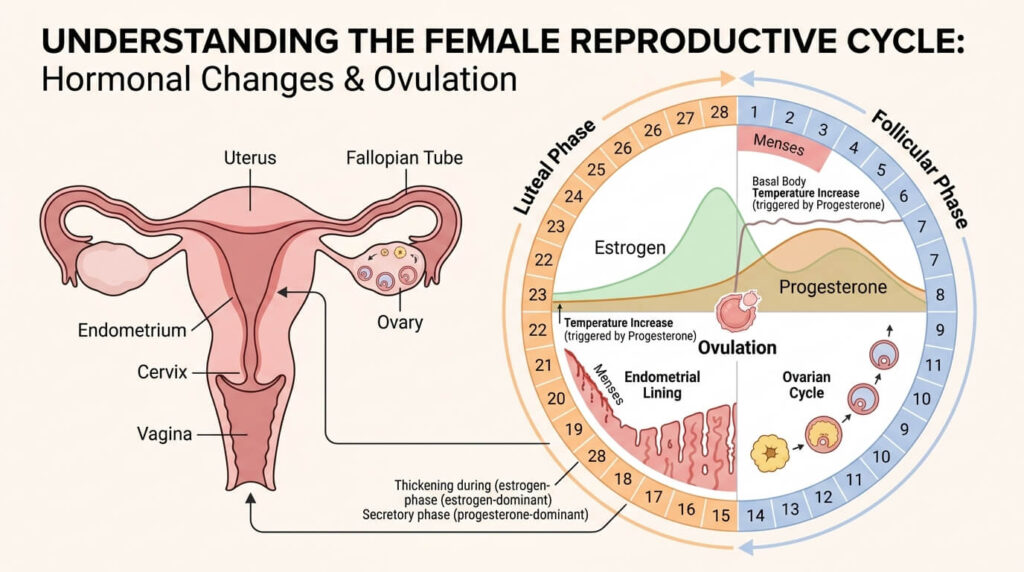
During the first half of your cycle (the follicular phase), BBT stays relatively low. After you ovulate, your body releases progesterone, a hormone that nudges your core temperature up by roughly half a degree to a full degree Fahrenheit. That small, sustained rise — not a single high reading, but a pattern held for several days — is the signal that ovulation has already occurred.
This is the central thing beginners get wrong: BBT doesn’t predict ovulation in advance. It confirms it after the fact. Used over a few cycles, though, it lets you spot your personal pattern and estimate your fertile window in future months.
Editorial note: this article reflects general fertility-education guidance. Readers should confirm any fertility-tracking approach, especially if using it for contraception, with an OB-GYN or fertility specialist, who can also review individual cycle irregularities a chart alone won’t explain.
What You Need Before You Start
You only need two things: a thermometer sensitive enough to detect small changes, and a way to record your readings daily.
Choosing a Basal Thermometer
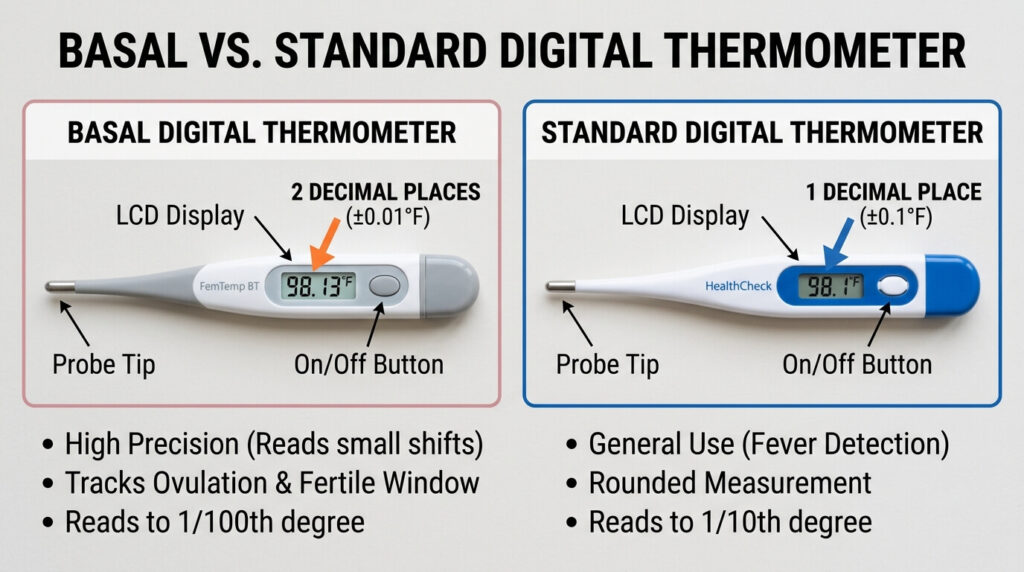
A standard digital thermometer rounds to the nearest tenth of a degree, which usually isn’t precise enough to catch the subtle BBT shift. A basal thermometer, by contrast, measures to two decimal places (for example, 98.13°F instead of 98.1°F), which makes the post-ovulation rise much easier to spot. Basal thermometers are inexpensive and widely available at pharmacies.
If you’d rather not manage a thermometer and chart manually, a growing category of wearable rings and watches now logs temperature continuously overnight and syncs to an app — useful if you tend to forget, but typically a larger upfront cost than a $10–$15 basal thermometer.

How to Take Your Basal Body Temperature, Step by Step
Step 1 — Take It First Thing, Before You Move
Keep your thermometer on your nightstand. Take your temperature the moment you wake up, before getting out of bed, talking, checking your phone, or even sitting up. Any activity — even brief movement — raises your temperature enough to skew the reading.
Step 2 — Take It at the Same Time Every Day
Aim for the same time each morning, ideally after at least three hours of uninterrupted sleep. A two-hour swing in wake time (sleeping in on weekends, for instance) can shift your reading enough to obscure the real pattern. If your schedule varies a lot — shift work, frequent early flights — note that on your chart so you can account for the inconsistency later.
Step 3 — Use the Same Method Each Time (Oral, Vaginal, or Rectal)
Most people take BBT orally, but vaginal and rectal readings tend to be slightly more sensitive to small changes. Whichever you choose, stick with it for the entire cycle — switching methods mid-cycle makes your chart unreliable, since each site reads slightly differently.
Step 4 — Record It Immediately
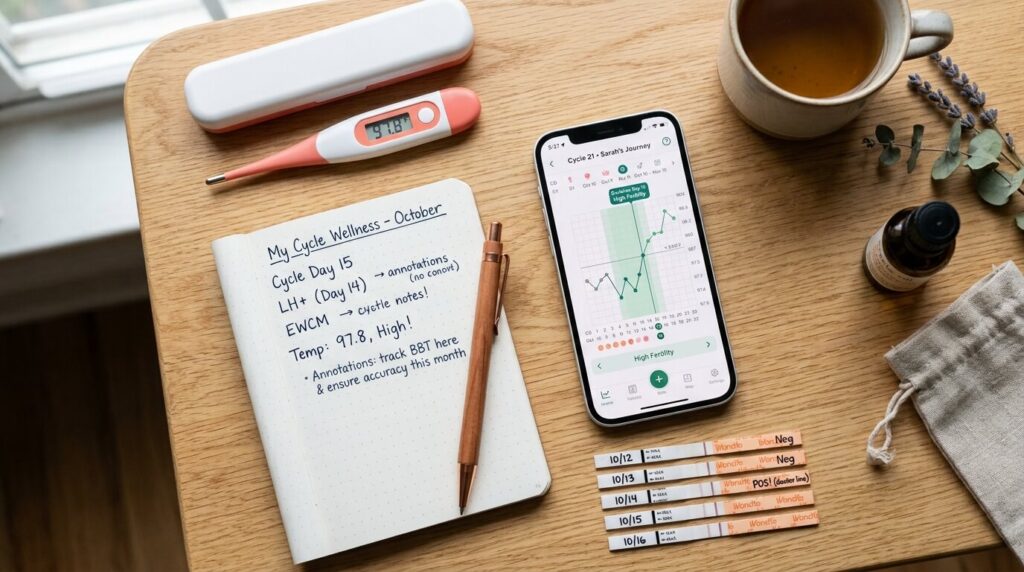
Log the number right away, either on a paper chart or in a fertility-tracking app, before you forget the exact reading. Apps have an edge here: most auto-plot your temperatures on a graph and flag the shift for you, which makes pattern recognition far easier than scanning a column of numbers.
What a Normal BBT Pattern Looks Like
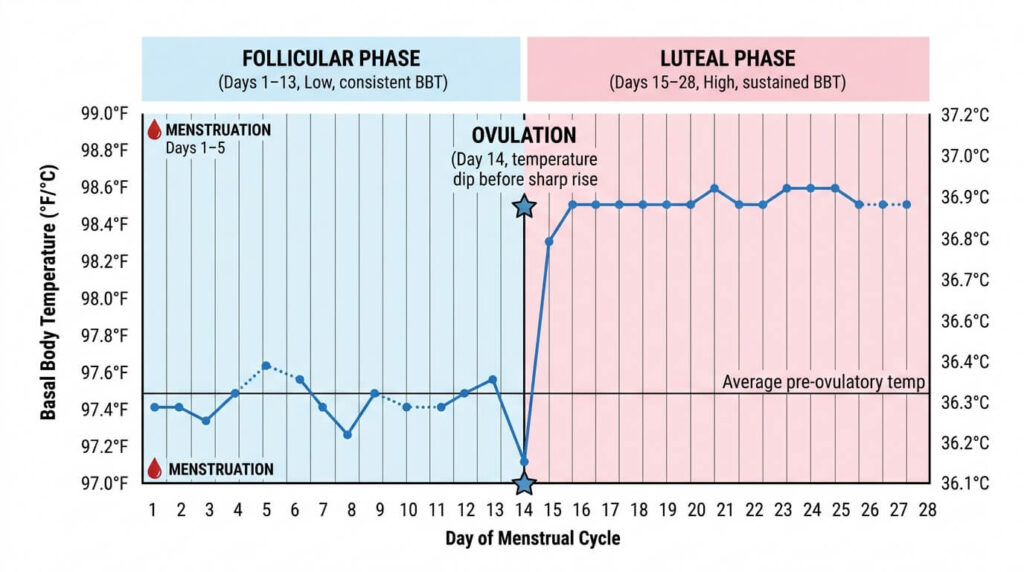
Sample BBT Chart: Spotting the Shift
Picture two flat-ish phases separated by a step up. For roughly the first half of the cycle, readings cluster in a lower range with normal day-to-day wobble. Then, over one to three days, temperatures jump and stay elevated through the rest of the cycle — that’s the ovulation signal. Some people notice a slight dip the day immediately before the rise, though this dip isn’t reliable enough to count on by itself.
| Cycle Day | Phase | Typical Temperature Pattern |
|---|---|---|
| 1–13 (varies) | Follicular (pre-ovulation) | Lower, relatively flat readings |
| ~14 (varies by person) | Ovulation | Possible brief dip, then rise begins |
| 15–28 (varies) | Luteal (post-ovulation) | Elevated, holds steady for 3+ days |
Typical Temperature Ranges Before and After Ovulation
Pre-ovulation BBT generally falls between about 96°F and 98°F (35.5–36.6°C). After ovulation, it typically rises to 97°F–99°F (36.1–37.2°C). The size of the jump varies by person — anywhere from roughly 0.4°F to 1°F — so the goal isn’t hitting an exact number, but recognizing your own sustained increase.
If your temperature stays elevated well past when your period would normally start, and your period doesn’t arrive, that sustained plateau (often noted around 18+ days post-ovulation) can be an early signal worth following up with a pregnancy test.
Common Mistakes That Throw Off Your Chart
Even careful trackers run into these issues:
- Inconsistent wake-up times. Sleeping in by even an hour can produce a falsely high reading.
- Forgetting a day. A single gap won’t ruin your chart, but mark it clearly rather than guessing or filling in an estimate.
- Illness or fever. A cold, infection, or fever raises temperature independent of ovulation, so flag sick days when reviewing your chart.
- Alcohol the night before. Alcohol can elevate resting temperature and distort the next morning’s reading.
- Travel and time zones. Jet lag disrupts both sleep timing and your body’s natural rhythm — try to keep readings at a consistent local time relative to wake-up, not clock time.
- Interrupted sleep. Fewer than three hours of continuous sleep before your reading can produce an inaccurate baseline.
- Switching thermometers or methods mid-cycle. Stay consistent for the full cycle for a chart you can actually compare month to month.
BBT Tracking Tools: Thermometer vs. Wearable vs. App
| Tool | Cost | Effort | Best For |
|---|---|---|---|
| Basal thermometer + paper chart | Low ($10–$15) | Manual daily entry | Budget-conscious beginners |
| Basal thermometer + tracking app | Low–moderate | Manual reading, auto-charted | Most users — easiest pattern-spotting |
| Wearable ring/watch | Higher (ongoing or one-time cost) | Passive, automatic | People prone to forgetting manual readings |
| Ovulation predictor kit (OPK) | Low–moderate | Daily urine test | Predicting ovulation before it happens, rather than confirming it after |
BBT and OPKs serve different purposes and work well together: OPKs detect the LH surge that precedes ovulation by about a day and a half, while BBT confirms that ovulation already happened. Many people pair BBT with cervical mucus observation or OPKs for a fuller picture — an approach sometimes called the sympto-thermal method.
How Accurate Is BBT for Avoiding or Achieving Pregnancy?
BBT is a useful, free way to learn your personal cycle pattern, but it has real limits. Because it only confirms ovulation after it’s already happened, it’s not well-suited as a stand-alone method for avoiding pregnancy — by the time you see the temperature rise, the fertile window has typically already passed for that cycle. Irregular cycles, illness, travel, and inconsistent timing all reduce its reliability further.
For people trying to conceive, BBT is most useful in combination with other signs (cervical mucus changes, OPKs) and after a few cycles of data, since it helps you anticipate timing for the next cycle rather than the current one. If you’re using fertility awareness for contraception, most providers recommend pairing it with a second method rather than relying on temperature alone.
FAQ: Basal Body Temperature Tracking
What time should I take my basal body temperature?
At the same time each morning, ideally after at least three hours of uninterrupted sleep, before getting out of bed or moving around.
What is a normal basal body temperature before ovulation?
Most people see readings between about 96°F and 98°F (35.5–36.6°C) before ovulation.
Does basal body temperature rise before or after ovulation?
It rises after ovulation, once progesterone increases — typically by 0.4°F to 1°F, sustained for at least three days.
Can I use a regular thermometer for BBT?
You can, but a basal thermometer (which reads to two decimal places) makes the small post-ovulation shift much easier to detect accurately.
How accurate is the BBT method for getting pregnant?
BBT confirms ovulation only after it has occurred, so it’s better for identifying your personal pattern over several cycles than for predicting the current cycle’s fertile window in real time.
What if I forget to take my temperature one day?
Mark the gap clearly on your chart rather than guessing. One missed day usually won’t ruin the overall pattern, but consistency matters most for the days surrounding your expected temperature shift.
Can BBT tell me I’m pregnant before a test?
A sustained elevated temperature lasting longer than your usual luteal phase (often 18+ days) can be an early hint, though it’s not a substitute for a pregnancy test.
How long does it take to see a pattern in my BBT chart?
Most people need at least three full menstrual cycles of consistent tracking before a reliable, repeatable pattern emerges.