Wondering if essential oils are safe for your baby? Pediatricians and medical experts weigh in. Discover which oils are safe by age, which to avoid entirely, how to dilute properly, and the warning signs every parent should know. Updated with CHOP and Johns Hopkins guidance. You’re standing in a wellness store, holding a tiny bottle of lavender oil. The label promises relaxation, better sleep, and calm — everything you desperately want for your baby. But is it actually safe to use around an infant?
The honest answer is: it depends — on the specific oil, your baby’s age, how you use it, and how much. Some essential oils can provide gentle benefits when used correctly. Others pose real risks, even in small amounts. Do you know can periods cause dizziness?
Here’s what pediatric medical experts and aromatherapy professionals actually recommend.
What Are Essential Oils — and Why Do They Affect Babies Differently?
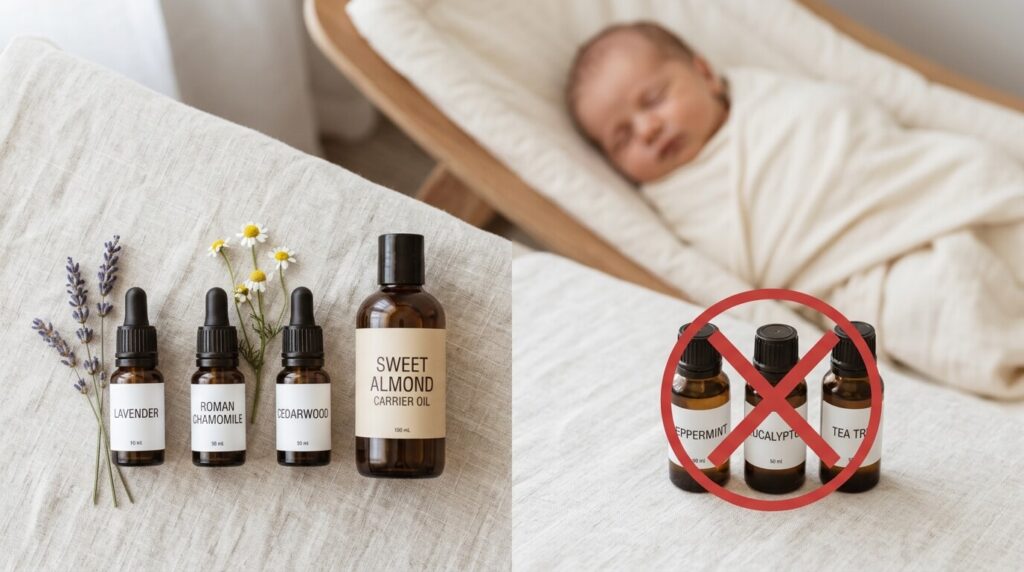
Essential oils are highly concentrated extracts taken from the flowers, leaves, seeds, bark, roots, or peel of plants. A single drop contains dozens to hundreds of active chemical compounds, which is why they smell so intense.
Adults can generally handle this potency (with sensible precautions). Babies cannot — not yet.
Babies Absorb More — Here’s Why
A baby’s skin is structurally different from adult skin. The lipid barrier — the protective layer that regulates what gets absorbed — is thinner and less mature. According to Dr. Anna Esparham, M.D., a board-certified pediatrician at Children’s Mercy Hospital who is also trained in aromatherapy, babies absorb significantly more through their skin relative to body surface area than adults do.
Their respiratory systems, sinuses, and nervous systems are also still developing. Chemicals that an adult metabolizes easily can overwhelm an infant’s physiology and affect both secretions and respiratory function.
The “Natural Doesn’t Mean Safe” Problem
One of the most common mistakes parents make is assuming that because essential oils are plant-derived, they’re automatically safe. This isn’t true. Strychnine, arsenic, and poison ivy are all natural. Concentration matters enormously.
The FDA does not regulate essential oils as drugs or medical treatments. Most products carry no specific infant safety warnings. This places the responsibility of safe use entirely on the parent — which makes knowing the facts critical.
Age-Based Safety: The Guidelines Every Parent Needs
There is no single rule for all babies. Age matters significantly when it comes to essential oil safety.
Essential Oils Safe For Babies
Newborns (0–3 Months): Avoid Entirely
Most experts, including pediatricians and professional aromatherapists, agree: do not use essential oils on or around newborns under three months of age, in any form — topical or diffused.
At this stage, a baby’s skin absorption is highest, their detoxification pathways are least developed, and their breathing patterns are most vulnerable. Even passive aromatherapy carries risk in a closed nursery.
Babies 3–9 Months: Proceed With Extreme Caution
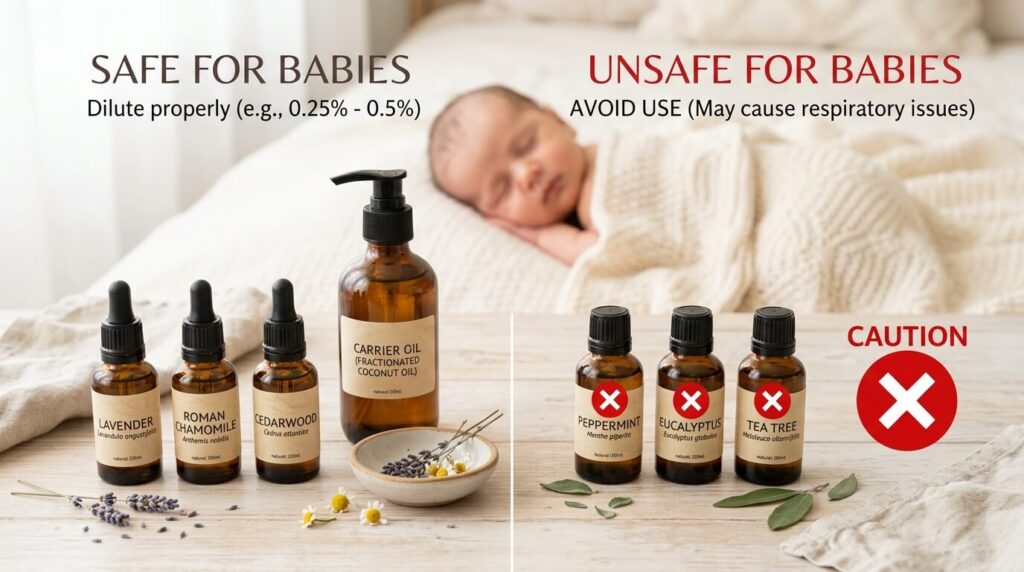
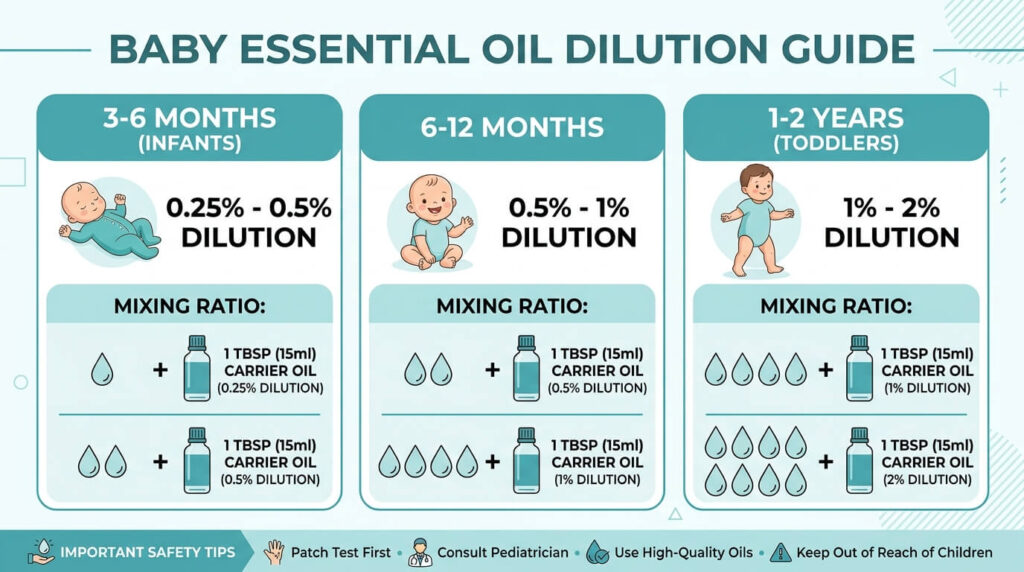
After three months, a small number of very gentle oils can be considered, but only with significant dilution (0.1–0.25%), proper ventilation, and a pediatrician’s guidance beforehand.
Dr. Esparham advises that most essential oils are not appropriate for general use with babies younger than nine months. Even oils widely considered “gentle” can affect a young baby’s developing respiratory and neurological systems.
If you do introduce any oil during this window, treat it like you would a new food: one oil at a time, watch for reactions, and stop immediately if anything seems off.
Babies 9–24 Months: Limited Use With Proper Dilution
Babies older than nine months can tolerate a slightly wider range of gentle oils — but the keyword is still “limited.” Dilution ratios remain very low (0.1–0.25%), diffusion sessions should be brief (5–10 minutes maximum), and ventilation is non-negotiable.
This is still not the time to freely experiment with oils. Stick to those with established safety profiles for infants and confirmed by qualified sources.
Essential Oils Generally Considered Safe for Babies
When used appropriately, a handful of oils have been studied or recommended by pediatric aromatherapy professionals as the gentlest options for infants older than three months.
Lavender (Lavandula angustifolia) Lavender is the most widely studied oil for infant use. Research has found that lavender aromatherapy can reduce pain response during vaccinations and ease symptoms of colic. One study found that a lavender-based aromatherapy patch helped reduce hospital stays for infants with neonatal abstinence syndrome. Use highly diluted (0.1–0.25%) and only after three months.
Roman Chamomile (Anthemis nobilis) Roman chamomile is another gentle option associated with calming effects. Like lavender, it has been studied in colic relief for infants. It’s considered one of the softer oils available.
Dill (Anethum graveolens) Dill oil is sometimes recommended by pediatricians and herbalists for digestive discomfort. It has a mild, herb-like profile and a low irritation risk at proper dilutions.
Cedarwood (Cedrus atlantica) Cedarwood is often cited as baby-friendly for its calming, grounding aroma. It is a common ingredient in baby-specific essential oil blends. Used in a passive diffuser with good ventilation, it can be a reasonable choice for older infants.
Important: Even “safe” oils must be diluted properly in a carrier oil before any skin contact, and introduced one at a time to identify any sensitivities.
Essential Oils You Must Never Use Around Babies
Several oils should be avoided around infants completely, regardless of dilution.
| Oil | Why It’s Dangerous |
|---|---|
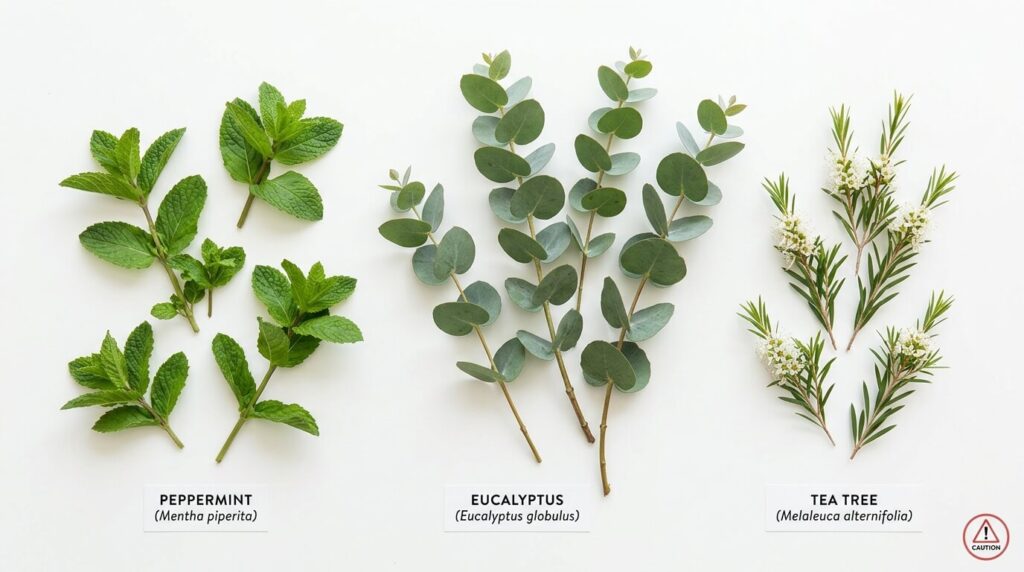
| Peppermint | Contains menthol, which can slow or stop breathing in infants; also associated with severe jaundice in babies with G6PD deficiency |
| Eucalyptus | High in 1,8-cineole, which can cause respiratory depression and neurological effects in young children |
| Wintergreen | Contains methyl salicylate, similar to aspirin; toxic in very small amounts |
| Rosemary | Some chemotypes contain high 1,8-cineole; Tisserand Institute advises against diffusing near infants |
| Clary Sage | Hormonal effects; not appropriate for infants |
| Hyssop | Contains pinocamphone, which can cause seizures |
| Idaho Tansy | Toxic compounds; never safe for infants |
| Tea Tree | Potentially toxic if ingested; skin sensitizer; not recommended for young babies |
| Camphor | Neurotoxic in small doses; cases of infant poisoning documented |
Even at trace amounts through diffusion, oils like eucalyptus and peppermint can irritate or compromise an infant’s airway. The Children’s Hospital of Philadelphia recommends using only oils that have been studied and found safe for children over three years of age — and applying even stricter standards for infants.
How to Safely Use Essential Oils Around Your Baby
If you choose to use essential oils around your baby (age 3+ months, with pediatrician guidance), method of use and dilution are everything.
Aromatherapy vs. Topical Application
Aromatherapy (inhaling via diffuser or passive means) is generally considered lower risk than topical application, but it still requires careful management in the nursery.
Topical application (diluted oil applied to skin) creates direct absorption and carries the highest risk of skin reactions and systemic absorption. Always dilute. Never apply to the face, near the eyes or nose, or on broken skin.
Ingestion — never, under any circumstances. Essential oils are toxic if swallowed. Even small amounts can cause serious harm.
Dilution Guide: How Much Is Safe? / Essential Oils Safe For Babies
| Baby’s Age | Dilution Ratio | Recipe |
|---|---|---|
| Under 3 months | Do not use | — |
| 3–24 months | 0.1–0.25% | 1 drop per 4–10 teaspoons of carrier oil |
| 2–6 years | 0.25–0.5% | 1 drop per 2–4 teaspoons of carrier oil |
These ratios are significantly lower than those recommended for adults (typically 2–3%). Do not scale up.
Which Carrier Oils to Use
Always dilute essential oils in a carrier oil before applying to baby’s skin. Good options include:
- Fractionated coconut oil — lightweight, odorless, widely tolerated
- Jojoba oil — closely mimics skin’s natural oils; very gentle
- Sweet almond oil — mild and nourishing; check for nut allergies first
- Sunflower oil — good for sensitive skin
Avoid mineral oil (petroleum-based) and products with added fragrances.
Diffuser Safety Rules
- Use a passive diffuser (reed sticks, aroma stones) whenever possible — they emit lower concentrations continuously
- If using an active diffuser, run it for no more than 5–10 minutes at a time in a well-ventilated room
- Keep the diffuser out of the nursery when the baby is sleeping; diffuse in an adjacent space if needed
- Open a window or door to ensure fresh air exchange
- Never diffuse in a car with an infant — there is no ventilation
- Use a diffuser designed specifically for essential oils (not a humidifier or nebulizer, which can use inappropriate-grade plastics and emit uncontrolled concentrations)

Warning Signs: When Your Baby Is Having a Reaction
Even safe oils can cause adverse reactions in some babies. Watch closely after introducing any new oil and stop use immediately if you notice any of the following.
Skin Reactions
- Redness, rash, or hives at the application site
- Swelling or irritation
- Blistering (rare but serious)
Respiratory Signs
- Faster, slower, or labored breathing
- Wheezing or coughing
- Sneezing persistently
- Pulling away from the scent or seeming distressed
Neurological or Systemic Signs
- Unusual drowsiness or lethargy
- Excessive crying or agitation after exposure
- Eye watering or rubbing
If you observe any breathing difficulty, loss of consciousness, or seizure-like activity, call 911 immediately.
What to Do in an Emergency
Skin exposure: Remove clothing and rinse the area with a plain carrier oil (not water — water can spread the essential oil further and increase irritation). Then rinse with mild soap and water.
Eye contact: Flush with cool water for 10–15 minutes. Seek medical attention.
Ingestion: Call Poison Control immediately at 1-800-222-1222. Do not induce vomiting. Time matters — act fast.
Safe Storage and Poison Control
Essential oils should be treated with the same care as medications:
- Store in tightly sealed, dark-glass bottles out of reach of children
- Use bottles with child-resistant caps or single-drop dispensers
- Never leave them on counters, diaper bags, or anywhere accessible to curious hands
- Even a teaspoon of certain essential oils (like wintergreen or eucalyptus) can be lethal to a small child if swallowed
Keep the Poison Control number saved in your phone: 1-800-222-1222
What the Experts Recommend
It’s worth being honest about where the medical consensus sits: the American Academy of Pediatrics (AAP) and the American Academy of Family Physicians have not issued formal recommendations for essential oil use in children, because the evidence base is still limited.
Johns Hopkins pediatrician Dr. Rachel Dawkins, M.D., emphasizes that while essential oils can be beneficial, understanding their origins and proper use is essential before applying them to children. She cautions particularly about synthetic fragrances marketed as essential oils — which carry none of the potential benefits but all of the risks.
The Children’s Hospital of Philadelphia specifically recommends limiting essential oil aromatherapy to children over age three, and using only oils with established safety profiles (lavender, peppermint for older children, citrus, ginger). For infants under three, their guidance is significantly more restrictive.
If you want to use essential oils around your baby, the safest path is:
- Wait until at least three months of age
- Consult your pediatrician first — especially if your baby has any respiratory conditions
- Choose a certified aromatherapist affiliated with NAHA (National Association for Holistic Aromatherapy) for guidance
- Start with one oil, use the lowest possible dilution, and observe carefully
- Never replace evidence-based medical treatment with essential oils
FAQ SECTION
Q1: Are essential oils safe for newborns?
No. Most experts and medical professionals recommend avoiding essential oils entirely for babies under three months old. A newborn’s skin barrier, detoxification systems, and respiratory pathways are not mature enough to handle concentrated plant compounds safely.
Q2: Can I diffuse lavender oil in my baby’s room?
If your baby is older than three months, brief diffusion (5–10 minutes) of diluted lavender in a well-ventilated room may be acceptable. However, do not diffuse directly in the nursery while your baby is sleeping, and always consult your pediatrician first.
Q3: What essential oils are safe for babies?
For babies older than three months, lavender, Roman chamomile, dill, and cedarwood are generally considered the gentlest options. All must be significantly diluted (0.1–0.25%) in a carrier oil before any skin use.
Q4: Which essential oils should I never use around my baby?
Avoid peppermint, eucalyptus, tea tree, wintergreen, clary sage, hyssop, rosemary (high 1,8-cineole types), camphor, and Idaho tansy. These contain compounds that can cause respiratory depression, seizures, or systemic toxicity in infants.
Q5: Is eucalyptus oil safe for babies in a diffuser?
No. Eucalyptus contains 1,8-cineole, which can slow or suppress breathing in infants and young children. It should not be diffused around babies under two years of age.

Q6: What dilution ratio is safe for essential oils on baby skin?
For babies aged 3–24 months, a 0.1–0.25% dilution is recommended. That means roughly 1 drop of essential oil per 4–10 teaspoons of carrier oil. Never apply undiluted oil to a baby’s skin.
Q7: Can essential oils help my baby sleep?
Some research suggests lavender aromatherapy can have a mild calming effect on infants. However, the evidence is limited, and the AAP has not endorsed essential oils as sleep aids. Practice safe sleep guidelines above all else.
Q8: Are essential oil diffusers safe in a nursery?
Passive diffusers (like reed sticks or aroma stones) are safer than active ultrasonic or nebulizing diffusers. Active diffusers should only be run briefly (5–10 minutes), in a ventilated room, with the baby not present during diffusion.
Q9: Can I put essential oils in my baby’s bath?
No. Essential oils do not properly dissolve in water and can concentrate on the surface, leading to intense skin exposure on sensitive infant skin. If you want to add aromatherapy to bath time for older babies, speak to a certified aromatherapist.
Q10: My baby accidentally touched essential oil. What should I do?
Rinse the skin with a carrier oil (like coconut oil) first, then wash with mild soap and water. If your baby ingested any essential oil or is showing respiratory symptoms, call Poison Control immediately at 1-800-222-1222.

Q11: Can I use essential oils on my baby for colic?
Some studies support the use of lavender or Roman chamomile massage (highly diluted) for colic relief in infants. However, always consult your pediatrician before trying this approach, and never exceed safe dilution ratios.
Q12: Are baby-specific essential oil blends safe?
Some brands formulate blends specifically designed for infant safety, using pre-diluted, age-appropriate oils. These are generally safer choices than adult formulations — but still read labels carefully and verify with your pediatrician.
Q13: What carrier oils are best for diluting essential oils for babies?
Fractionated coconut oil, jojoba oil, and sweet almond oil are among the best choices. They are lightweight, well-tolerated by sensitive skin, and odorless (or very mild).
Q14: Can I use peppermint oil for my baby’s congestion?
No. Peppermint oil contains menthol, which can cause breathing to slow or stop in infants. It has also been linked to severe jaundice in babies with G6PD deficiency. Use saline drops and a nasal aspirator instead — methods backed by pediatric evidence.
Q15: Where can I find a qualified aromatherapist for baby-safe guidance?
Look for an aromatherapist certified through the National Association for Holistic Aromatherapy (NAHA) or the Alliance of International Aromatherapists (AIA). They will have specific training in pediatric applications.